
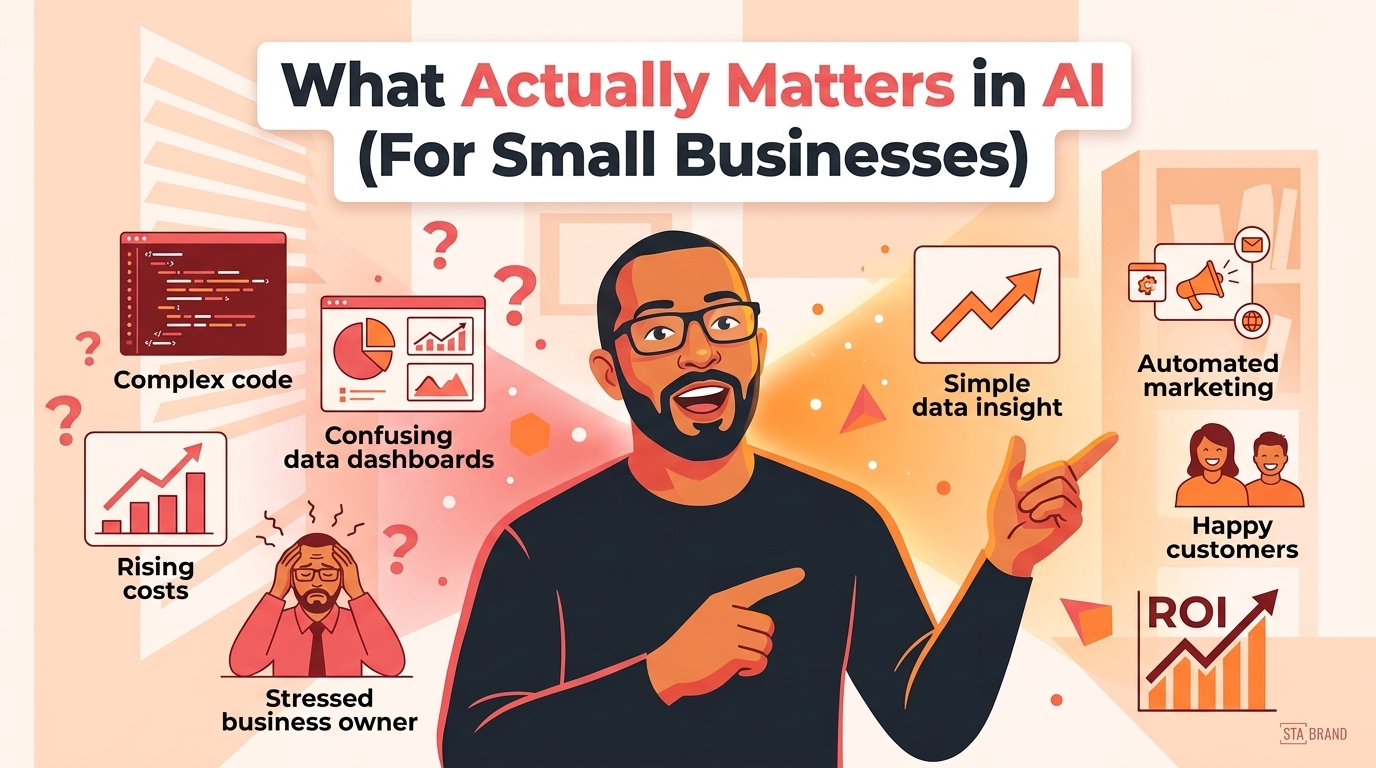
Most businesses think staying ahead in AI means keeping up with every new model, every new demo, and every new headline.
But that approach is quietly leading them in the wrong direction.
Because while many companies are distracted by what AI can do, the ones actually winning are focused on how AI fits into their operations. They are not chasing tools. They are redesigning how their business runs, focusing on why most automation projects fail without proper workflow design. And that distinction is what separates momentum from stagnation.
The Biggest Misconception About AI Adoption
The most common mistake businesses make is assuming AI is an information problem.
They believe that if they learn more tools, they will move faster. If they test more platforms, they will find the solution. If they stay updated, they will stay competitive.
But the reality is simpler and more uncomfortable. Most of what you see about AI has very little to do with how your business actually operates. That is where the gap begins.
AI does not create results just because it exists. Results come from applying it inside a well-designed workflow where tasks, handoffs, and decisions are already clear.
Why Businesses Get Stuck Despite Using AI Tools
Many companies have already started using AI. They have subscriptions, platforms, pilots, and experiments. But nothing fundamentally changes.
That happens because the underlying workflows are still broken. Instead of improving operations, AI simply accelerates the inefficiencies that were already there.
- Messy processes become faster messy processes
- Poor communication becomes faster confusion
- Delays become automated delays
AI will not fix a broken system. It will expose it, which is why understanding where AI should actually start inside your business operations is critical.
The Real Shift: From Tools to Workflows
AI is no longer about what it can do. It is about what it should be doing inside your business.
The right question is no longer, “What can this tool do?” The right question is, “Where is my business losing time every single day?”
That is where AI creates real value. Not in theory. In execution. Research from recent McKinsey AI adoption reports shows that companies focusing on operational integration outperform those experimenting with tools alone.
Where AI Actually Creates Value
If you look closely at daily operations, the same pattern shows up again and again. Businesses are overloaded with repetitive coordination tasks that keep work moving but do not create strategic value.
- Email responses
- Follow-ups
- Scheduling
- Customer inquiries
- Lead management
- Internal updates
These tasks are necessary, but they consume time, create drag, and slow down growth when they are handled manually.
A Practical AI Workflow Strategy Framework
To make AI work in a real business environment, you need a system-first approach. That means starting with workflow clarity before introducing automation.
Identify operational friction
Look for delayed responses, missed follow-ups, manual coordination, repetitive communication, and recurring bottlenecks that slow execution.
Map the workflow
Break the process into clear steps. Define what triggers the workflow, what happens next, who is involved, and where delays usually appear.
Remove bottlenecks
Simplify before automating. Eliminate unnecessary steps, standardize routine actions, and make responsibilities easier to understand.
Introduce AI execution
Once the workflow is clear, use AI to handle repetitive tasks, trigger next steps, and keep processes moving with consistency and speed.
Optimize continuously
Track performance improvements, monitor reduction in manual work, and refine the system as the business scales.
A Practical Example: Manual vs Automated Operations
Consider a typical service-based business managing inbound leads from multiple channels.
Before AI
- Leads arrive from different channels
- Someone checks each platform manually
- Responses are delayed
- Qualification happens inconsistently
- Follow-ups are missed
The result is lost opportunities, not because demand is missing, but because the system cannot keep up.
After workflow optimization + AI
- Leads trigger instant responses
- Basic questions are handled immediately
- Information is collected automatically
- Next steps are initiated without delay
- Humans step in at the right moment
This is not about replacing people. It is about removing friction and allowing the business to move faster with less effort.
The Role of AI Employees in Modern Operations
This is where AI employees become important. They are not just tools someone opens once in a while. They are digital workers assigned to specific roles inside a workflow, similar to how AI employees function as role-based digital workers in modern businesses.
They can handle follow-ups, customer communication, lead engagement, operational coordination, and repetitive internal support tasks.
They do not replace your team. They remove the repetitive workload that limits your team’s effectiveness, so your people can focus on strategy, relationships, and higher-value decisions.
The Future: Human + AI Hybrid Operations
The conversation around AI often centers on job replacement, but that is the wrong framing. AI is not replacing jobs. It is replacing tasks.
That creates a new operating model: a hybrid workforce where humans and AI work together. AI handles execution. Humans handle judgment. AI creates speed. Humans create direction.
Businesses that understand this shift early gain a structural advantage. They move faster, scale smarter, and operate with less friction. According to Deloitte’s research on AI adoption in business operations, organizations that embed AI into workflows see significantly higher efficiency gains than those using it in isolation.
Why System-First Thinking Is the Real Advantage
At the core of all of this is one principle: AI should follow the workflow, not the other way around.
If you do not understand how work moves through your business, you cannot automate it effectively, scale it efficiently, or improve it consistently. Adding more tools without fixing workflows only increases complexity. Designing the system first creates clarity, and clarity is what makes AI work.
Conclusion: Stop Chasing AI, Start Fixing Workflows
The businesses seeing real results with AI are not the ones experimenting the most. They are the ones thinking differently.
They are identifying bottlenecks, reducing manual work, designing better workflows, and using AI to execute with precision. That is what actually matters right now.
Final Takeaway
AI is not the advantage. Knowing where to use it is.
The businesses that remove operational friction first will respond faster, operate more efficiently, and scale with less effort. In a business environment where speed comes from removing friction instead of adding pressure, those are the companies that win.