
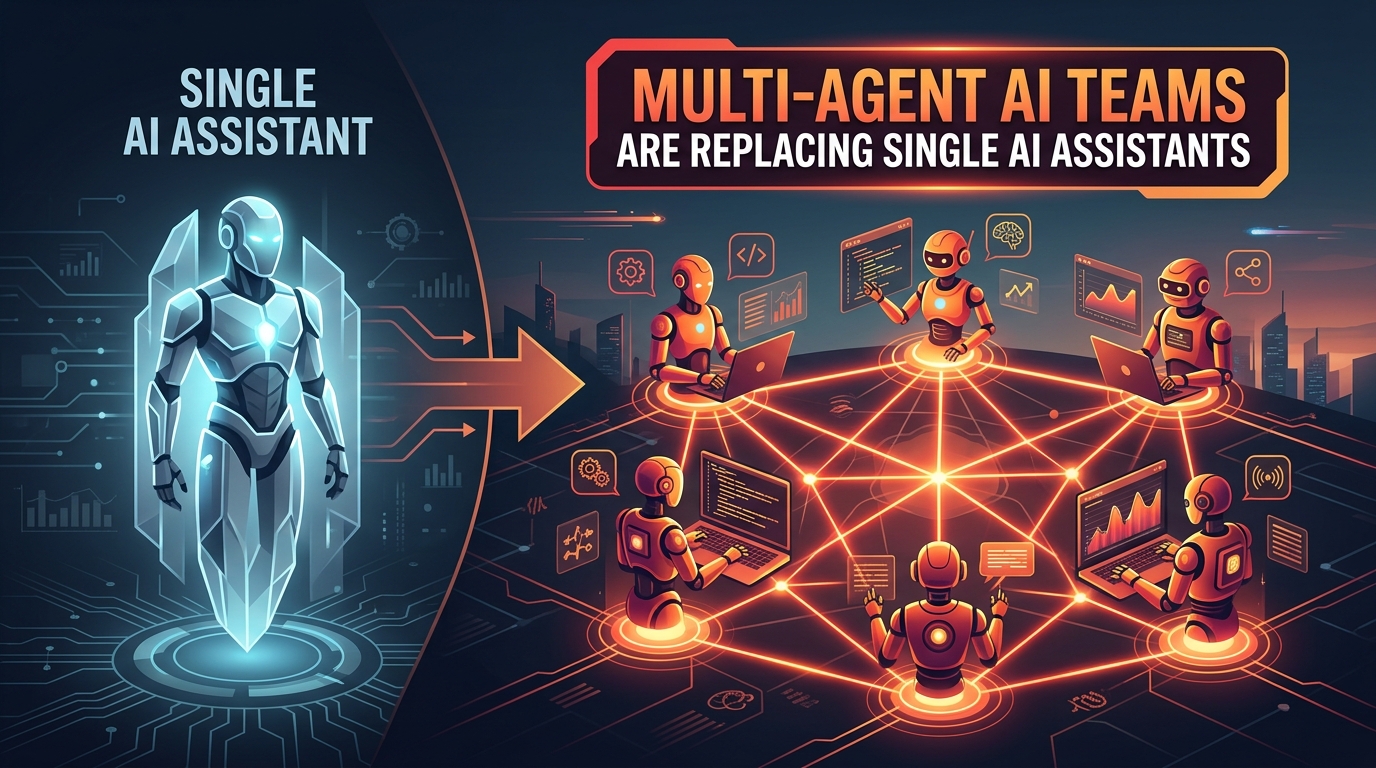
For the last few years, most businesses treated AI like a personal productivity tool. They gave employees access to a chatbot, asked teams to experiment with prompts, and hoped that faster writing, faster research, and faster summaries would lead to better business results.
That first wave mattered. It helped companies understand what AI could do. But it also exposed a major limitation: a single AI assistant can help with a task, but most businesses do not run on single tasks. They run on workflows, handoffs, approvals, customer requests, follow-ups, reporting cycles, and repeatable operational systems.
That is why multi-agent AI teams are becoming the next serious evolution in automation. Instead of relying on one assistant to do everything, businesses are beginning to deploy specialized AI agents that work together like a digital department.
Why Single AI Assistants Are Reaching Their Limit
A single AI assistant can draft an email, summarize a meeting, create a report, or answer a question. That is useful, but it is not the same as running a business process.
Think about what happens when a new lead enters a company. The lead must be captured, qualified, followed up with, scheduled, entered into the CRM, routed to the right person, and reported to management. One AI assistant may help with part of that process, but it does not naturally manage the entire workflow from beginning to end.
This is where companies start to realize that AI tools alone are not enough. If the workflow is still manual, disconnected, and dependent on human follow-up, the business has not transformed. It has only added a faster assistant on top of the same old process.
Watch: Why Multi-Agent Teams Matter
The video below breaks down the same core idea this article is built around: the future of AI in business is moving from individual assistants to coordinated teams of digital workers.
What Multi-Agent AI Teams Actually Are
A multi-agent AI team is a group of specialized AI agents designed to work together toward a shared business outcome. Each agent has a role, responsibility, input, output, and defined place inside the workflow.
Instead of asking one general assistant to handle everything, a company can build a team of focused digital workers. One agent captures the lead. Another qualifies it. Another sends follow-up messages. Another updates the CRM. Another prepares reports for leadership.
This is closely aligned with the idea of building digital workers into modern business operations, where AI is not treated as a passive chatbot but as an operational layer that performs structured work.
Why Multi-Agent Systems Are Better for Workflow Automation
Business work is rarely linear. It often requires coordination across systems, departments, customers, and decision points. A customer service request may need classification, response drafting, knowledge lookup, escalation, and follow-up. A finance workflow may need document collection, verification, approval routing, and reporting.
Multi-agent AI teams fit this reality because they are designed around specialization. Each agent handles one piece of the workflow, then passes the work forward. This creates cleaner execution, better accountability, and more reliable automation.
McKinsey has described agentic AI as a shift from systems that simply assist people to systems that can execute multistep processes and reshape workflows. That is why businesses need to think beyond tools and start designing the operating systems that allow agents to work safely, clearly, and effectively. McKinsey’s explanation of agentic AI and workflow transformation reinforces this shift.
The Biggest Mistake Companies Make With AI Agents
The biggest mistake is treating AI agents like another software subscription.
Many companies rush into agentic AI without mapping their workflows first. They buy tools, test features, and experiment with prompts, but the underlying business process remains unclear. When that happens, AI does not remove friction. It can actually amplify confusion.
A broken workflow does not become strategic just because AI is added to it. The company must first understand how work moves, where delays happen, what decisions need rules, where humans must approve, and which systems need to stay connected.
This is why intelligent automation that connects AI, logic, and business systems is more valuable than isolated AI experimentation. The system matters more than the tool.
A Practical Framework for Building Multi-Agent AI Teams
Businesses do not need to automate everything at once. The better approach is to start with one high-friction workflow and design the agent team around that process.
Map the Workflow
Document the steps, handoffs, decisions, systems, and bottlenecks involved in the process before adding AI.
Define Agent Roles
Create specialized agents with clear responsibilities instead of relying on one general assistant to do everything.
Connect the Systems
Make sure agents can access the right data, update the right tools, and pass information through the workflow.
Keep Humans in the Loop
Use human oversight for approvals, exceptions, compliance, quality control, and strategic decisions.
Examples of Multi-Agent Teams in Business
Sales Operations
A sales team can use one agent to capture leads, another to qualify them, another to send follow-ups, another to schedule calls, and another to update the CRM. The human sales team focuses on conversations and closing.
Customer Service
A support workflow can include an intake agent, classification agent, knowledge retrieval agent, response drafting agent, escalation agent, and satisfaction follow-up agent.
Operations and Administration
Back-office teams can use agents to process forms, route approvals, update records, generate reports, and notify stakeholders when action is needed.
Marketing Execution
A marketing workflow can include agents for research, content drafting, social repurposing, email creation, publishing, performance tracking, and reporting.
The Business Impact of Multi-Agent AI Teams
The real value of multi-agent AI teams is not just speed. It is consistency. A well-designed agent team can reduce manual work, improve response times, prevent missed follow-ups, and make operations easier to scale.
This matters because businesses often grow into complexity. More leads, more customers, more messages, more approvals, and more reporting requirements create more operational drag. Multi-agent systems help companies scale execution without adding the same amount of manual overhead.
In practical terms, multi-agent teams help businesses move from reactive work to designed execution. The company is no longer depending on people to remember every step. The workflow itself carries more of the operational burden.
The Future Is AI Teams, Not Just AI Tools
Single AI assistants will still be useful. They will continue helping individuals write, research, summarize, and think faster. But the businesses that gain the greatest advantage will go further.
They will build AI employees, digital coworkers, and multi-agent teams directly into their operating model. They will not just ask, “Which AI tool should we use?” They will ask, “Which workflow should we redesign, and what digital team should execute it?”
That is the difference between using AI and scaling through automation.
Final Takeaway
Multi-agent AI teams are replacing single AI assistants because business growth depends on workflows, not isolated tasks. The future belongs to companies that design coordinated AI teams around real operational outcomes, with humans supervising the system instead of manually carrying every step.