
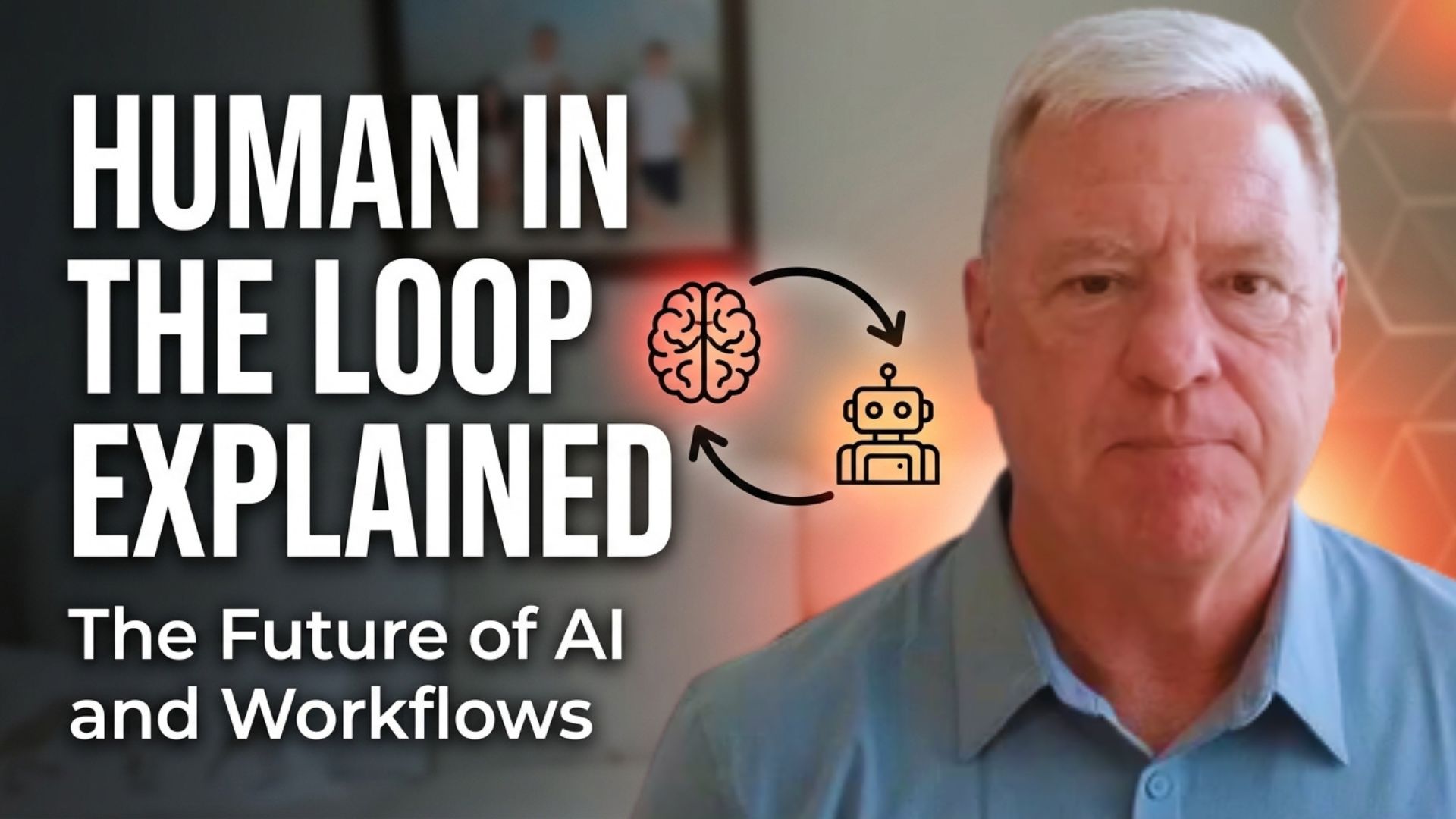
For years, conversations around artificial intelligence have focused on one dramatic question: will AI replace humans? But that question misses where business operations are actually heading.
The future of work is not humans versus AI. It is humans directing AI. That shift is already happening inside some of the most efficient businesses today. Modern companies are not removing people from operations entirely. Instead, they are redesigning workflows so artificial intelligence handles repetitive execution while humans supervise, approve, optimize, and guide the process.
This operating model is called Human in the Loop AI. Businesses that understand it early are building a major advantage in speed, consistency, and operational scale.
Human in the Loop AI is not about removing people from the process. It is about removing unnecessary friction from the process so people can operate at a higher level.
Why Most Businesses Misunderstand AI Adoption
Right now, many companies fall into one of two extremes.
The first group tries to continue operating fully manually. Teams are overloaded with repetitive tasks, constant follow-ups, administrative work, data entry, scheduling, and endless operational coordination.
The second group rushes toward full AI replacement without understanding workflow design. They assume adding AI tools automatically creates efficiency.
Neither approach works long term. Manual operations eventually create bottlenecks, burnout, slow response times, and inconsistent execution. Blindly replacing humans with automation can also create disconnected systems that lack oversight, judgment, and strategic decision-making.
The real opportunity exists between those two extremes. That is where Human in the Loop AI becomes powerful.
What Human in the Loop AI Actually Means
Human in the Loop AI is a workflow model where artificial intelligence handles the majority of execution while humans supervise the moments that require judgment, decision-making, creativity, or business context.
In simple terms, AI executes and humans supervise.
Instead of employees spending their day buried in repetitive operational tasks, they move into a higher-level role where they manage outcomes, monitor workflows, approve important actions, and optimize performance.
This changes the role of work itself. Your team is no longer consumed by manual execution. They become operators of intelligent systems.
Why Fully Manual Operations No Longer Scale
Many businesses still operate with workflows designed for a pre-AI environment. That creates friction everywhere.
- Leads wait hours for responses.
- Customer follow-ups get missed.
- Internal approvals move slowly.
- Teams spend too much time updating systems manually.
- Operational visibility becomes fragmented.
The issue is not usually effort. It is workflow structure. Most operational delays come from humans being forced to manage tasks that do not actually require human thinking.
This is why businesses pursuing stronger workflow automation systems for scalable operations are focusing less on isolated tools and more on redesigning execution itself.
Speed today comes from reducing operational friction, not increasing workload.
The Real Role of Humans in AI-Driven Workflows
One of the biggest misconceptions about AI is that businesses must choose between people or automation. That is not how modern operational systems work.
Artificial intelligence is extremely effective at repetitive execution. It can respond to inquiries instantly, manage follow-up sequences, process information, update systems, route workflows, monitor operational triggers, generate reports, and handle repetitive communication.
But AI still does not understand your business the way your people do. It lacks the full context behind relationships, priorities, brand standards, customer nuance, and strategic judgment.
Humans remain essential where interpretation, nuance, leadership, and oversight matter most. This is why successful companies are creating workflows where AI handles repetitive motion while humans focus on high-value decisions.
AI Handles Execution
Repetitive tasks, lead responses, follow-ups, updates, routing, and information processing move automatically.
Humans Supervise Outcomes
Your team steps in for approvals, judgment calls, exceptions, optimization, and business-critical decisions.
Workflows Stay Controlled
Automation runs inside a clear operational structure instead of creating disconnected activity across tools.
The Business Scales
Teams reduce manual work while improving speed, consistency, visibility, and operational efficiency.
How AI Employees and Human Oversight Work Together
Inside modern operations, AI employees are increasingly becoming execution layers within the business. These systems can follow up with leads automatically, route support inquiries, trigger operational workflows, organize data, manage scheduling coordination, deliver internal notifications, and handle repetitive communication tasks.
But instead of operating independently without oversight, they work inside controlled workflow systems supervised by people.
This is where the concept of AI employees built into real business workflows becomes strategically important. The goal is not removing people entirely. The goal is removing unnecessary manual workload while keeping humans in control of critical outcomes.
That is the difference between chaotic automation and intelligent operational design.
The Operational Benefits of Human in the Loop Systems
Businesses implementing Human in the Loop AI workflows often experience improvements across several operational areas simultaneously.
Faster Response Times
AI systems can respond immediately while humans oversee exceptions or escalations.
Improved Operational Consistency
Workflows execute the same way every time, reducing human error and operational gaps.
Reduced Manual Work
Teams spend less time on repetitive tasks and more time on strategic activities.
Better Scalability
Operations can grow without increasing headcount at the same rate.
Stronger Team Focus
Employees shift toward problem-solving, optimization, customer relationships, and business growth.
This is why many organizations exploring business automation strategy for operational efficiency are redesigning workflows before adding additional staff.
Where Businesses Create the Most Friction Today
Most operational friction appears in areas businesses rarely question because those processes have existed for years.
- Manual lead qualification
- Slow approval chains
- Repetitive customer updates
- Administrative coordination
- Internal handoffs
- Data synchronization
- Scheduling bottlenecks
- Reporting delays
Individually, these problems may seem small. Collectively, they create enormous operational drag. Disconnected tools rarely create transformation. Workflow redesign does.
The Workflow Redesign Shift Businesses Must Make
The businesses gaining the biggest advantage from AI are not simply buying more software. They are redesigning how work moves through the organization.
That means asking better operational questions. Which tasks truly require human judgment? Which processes can execute automatically? Where does friction slow down operations? Which workflows create delays or inconsistencies? How can humans supervise instead of manually execute?
This is the foundation of a strong AI workflow strategy for modern business operations.
Many businesses still focus on tools before understanding process architecture. But AI only amplifies the workflows it is connected to. If the workflow is inefficient, automation simply scales inefficiency faster.
Why Smart Companies Are Building AI-Supervised Operations
The next generation of scalable businesses will not operate like traditional organizations. Their teams will spend less time performing repetitive tasks and more time directing intelligent operational systems.
Employees will increasingly function as workflow supervisors, decision-makers, process optimizers, strategic operators, and escalation managers. Meanwhile, AI systems will continuously handle execution at speed.
This shift creates a major competitive advantage because businesses become faster, more efficient, more scalable, more consistent, and less operationally dependent on manual coordination.
The companies adopting this model early are not simply becoming more automated. They are becoming operationally redesigned.
Conclusion
Human in the Loop AI represents one of the most important shifts happening in modern business operations. The future is not about replacing humans completely. It is about elevating human contribution while intelligent systems handle repetitive execution.
Businesses that continue operating fully manual workflows will struggle with increasing operational friction, slower response times, and scaling limitations. But businesses that redesign operations around AI-supervised workflows will move faster, operate more consistently, and scale more efficiently.
The real opportunity is not removing people from the process. It is removing unnecessary friction from the process. And that changes everything.
Final Takeaway
The future of work belongs to businesses where AI executes and humans supervise.
Companies that understand Human in the Loop AI today are building the operational systems that will define tomorrow’s competitive advantage. If your business is still relying heavily on manual execution, now is the time to rethink how work actually flows through your organization.
Because the businesses scaling fastest are no longer doing everything manually. They are designing smarter systems.