
1
Define the Workflow
Clarify what happens first, what happens next, who owns each step, and what triggers the next action.
Wilton Rogers
April 23, 2026
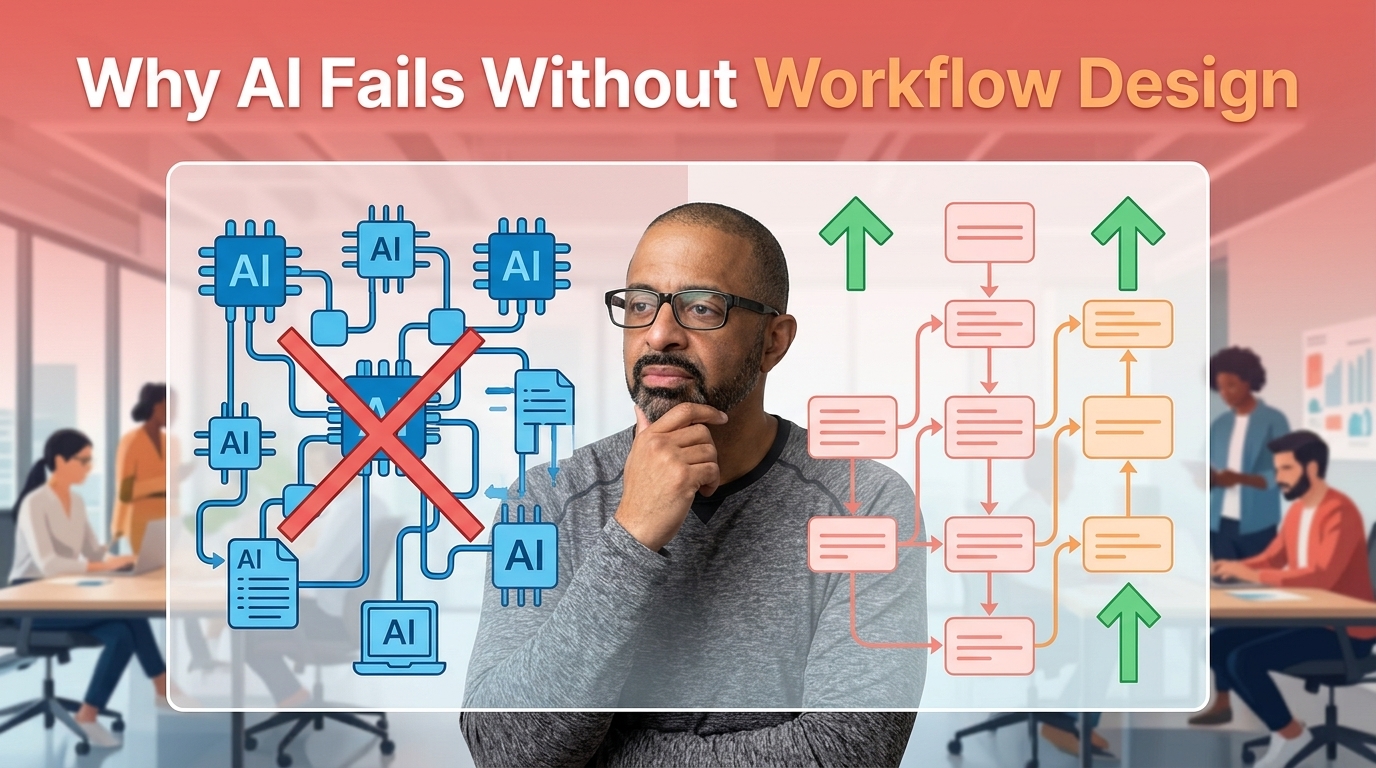
Most businesses do not fail with AI because the tools are weak. They fail because automation is layered on top of broken workflows. Real scale starts with operational clarity.
Most businesses believe AI will help them scale.
Faster operations. More output. Less manual work.
But what actually happens is very different.
Instead of scaling efficiency, they scale confusion. They move faster, but with more errors. They automate tasks, but not outcomes. They increase speed, but lose control.
And that is where the real problem begins.
AI does not fix broken operations. It amplifies them.
When most companies introduce automation, they are not improving their systems. They are accelerating them.
If the underlying process is unclear, inconsistent, or fragmented, automation simply pushes those same issues through the business faster. This is why having a clear business process automation strategy for scaling operations becomes critical before introducing any AI system.
From the outside, everything looks more efficient. But internally, things feel worse. More pressure. More mistakes. More confusion.
When a broken workflow gets faster, it does not become better. It becomes harder to control.
The mistake is not technical. It is strategic.
Most business owners approach AI like a tool problem instead of a workflow problem. Instead of focusing on structure, they skip the foundational step of identifying operational bottlenecks inside their workflows where automation should actually be applied.
They think they just need the right automation tool, a time-saving system, or more speed.But speed without structure creates instability.
The real issue is that most businesses have never clearly defined how work should flow. Processes are often undocumented, dependent on memory, inconsistent across team members, and unclear in ownership and handoffs.
Over time, that starts to feel normal. Until automation exposes it.
AI is not magic. It is a force multiplier.
That means it increases whatever already exists inside your business.
If your operations are clear and structured, AI improves speed and consistency. If your operations are broken, AI accelerates the breakdown.
This is why many companies say, “We tried automation, but it didn’t work.” In reality, the tool often worked exactly as expected. It amplified the system it was placed into. Research from global AI adoption studies by McKinsey consistently shows that companies only see meaningful impact when AI is embedded into well-designed workflows, not layered on top of fragmented processes.
If you want automation to actually create value, you need to reverse the typical approach. Instead of starting with tools, you start with structure.
Clarify what happens first, what happens next, who owns each step, and what triggers the next action.
Look for delays, repeated questions, missed handoffs, and duplicated effort where value gets lost.
Create documentation, decision rules, and predictable steps before you automate anything.
Introduce AI only after clarity exists so it can support execution instead of multiplying confusion.
If you are currently considering automation, pause and evaluate your business using better questions:
These answers reveal where the real problem is. Not in a lack of tools, but in a lack of operational clarity.
When workflows are designed properly, AI changes how the business operates. Instead of acting like a simple tool, it becomes part of the system.
This is where AI employees and digital coworkers start to make sense. When implemented correctly, they function within systems designed for scale, similar to how AI employees operate as structured digital workers inside business workflows rather than acting as disconnected tools.
They are not just assisting. They are executing within defined processes.At this stage, AI is no longer adding complexity. It is removing it.
The difference between chaotic automation and strategic automation is massive. Businesses that focus on workflow first experience measurable improvements across the operation.
Clear processes reduce dependency on individuals and make execution easier to manage.
Tasks are executed consistently without manual intervention slowing the business down.
Operations can handle more volume without breaking under added complexity.
Teams are no longer forced to hold together broken systems through memory and effort alone.
Most businesses do not fail at AI because of technology. They fail because they automate before they design. They add speed before structure. They chase tools instead of clarity.
And as a result, they scale the very problems they were trying to solve.
The solution is not more automation. It is better workflow design.
AI will not fix your business. But it will reveal how your business actually operates.
If your workflows are clear, AI will help you scale efficiently. If they are not, AI will scale the chaos.
The companies that win are not the ones using the most AI. They are the ones who understand how work should flow and then use AI to strengthen it.
Let us show you exactly where to start.
👉 Schedule a Free Automation Assessment
Welcome!
Meet your team of 24/7 AI Assistants. Each built to help your business run smarter and faster. Choose how you’d like to connect:
Call Mira - Your AI-Powered Voice Assistant
Reach out to Mira anytime at (817) 809-3820
for instant support and to see how AI and automation can transform...
your business. Mira can walk you through our services, answer questions, and even schedule a demo - all in real time.
Read more..
Talk Live with Nova - Your Online AI Voice Agent
Want a real conversation right here online? Nova can speak with you directly through your browser. No downloads...
, no wait times. Ask about automation, AI Employees, or how STA can streamline your operations. Nova is standing by for a one-on-one chat right now.
Read more..
Chat Instantly with Seren - Your AI Conversation Partner
Prefer to text? Seren is your instant connection for quick answers, resources, or a guided walkthrough of how we help businesses...
like yours automate and scale. Type your question and Seren will reply in real time.
Read more..
© 2026 ScaleThroughAutomation, All right reserved.