
1
Identify workflow friction
Start by finding the repetitive tasks, admin-heavy activities, coordination slowdowns, and data bottlenecks that absorb valuable employee time every day.
Wilton Rogers
March 13, 2026
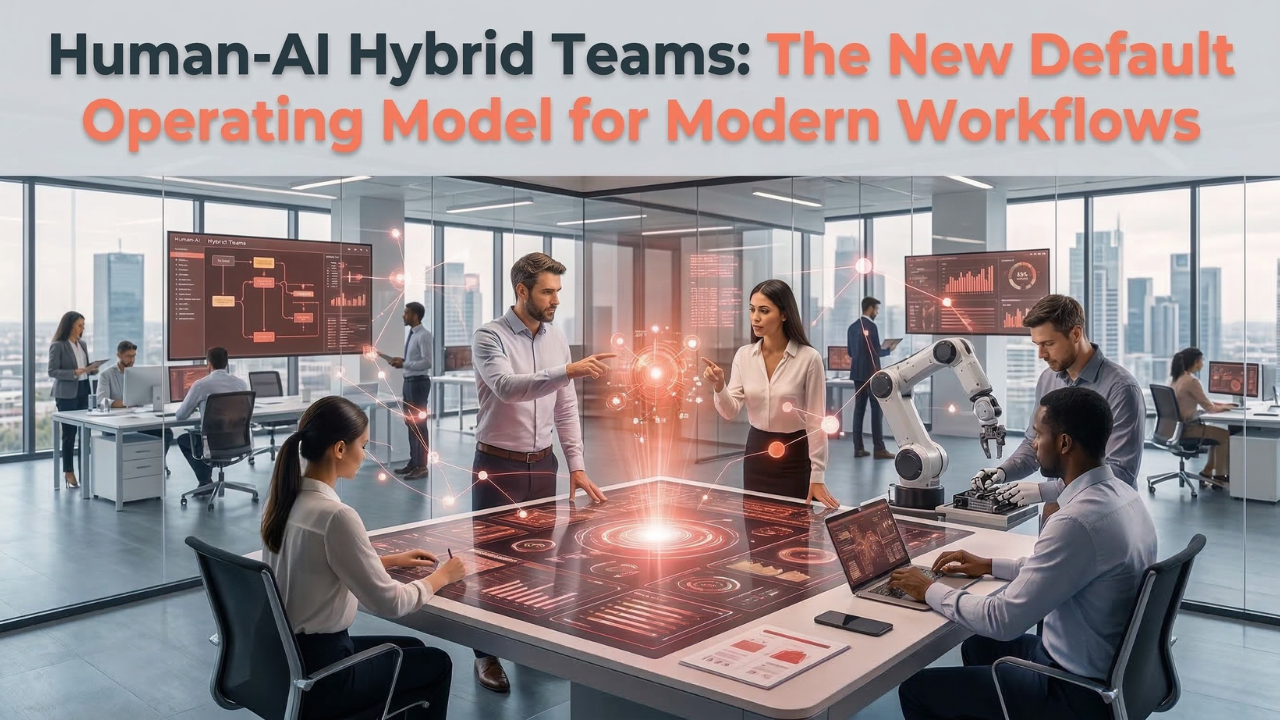
Modern businesses are no longer choosing between human talent and AI. They are redesigning workflows so both can work together inside the same operating model, creating faster systems, less manual work, and more scalable execution.
For years, the default way to scale a business was simple. Add more people, expand departments, and hope the growing workload could be managed through headcount alone. That model is now being challenged by a more effective structure: human-AI hybrid teams.
Instead of treating artificial intelligence as a replacement for employees or as a disconnected tool sitting outside the business, modern companies are beginning to integrate AI directly into the flow of work. The result is a new operating model where human expertise and AI execution work together in the same system.
At Scale Through Automation, this is the real conversation businesses should be having. The future of work is not about random AI adoption. It is about building practical workflow systems where humans focus on judgment, creativity, communication, and strategy while AI handles repetitive coordination, processing, and information-heavy execution.
Many companies still approach AI with the wrong question. They ask whether AI will replace people. That question leads to fear, confusion, and poor implementation decisions. A better question is this: where should human capability end and where should AI capability begin inside a workflow?
The most effective organizations are not removing humans from the process entirely. They are redistributing work more intelligently. In a hybrid model, AI takes on the tasks that are structured, repetitive, time-consuming, or dependent on rapid data handling. Human team members remain responsible for interpretation, relationship management, strategic thinking, approval, and exception handling.
AI creates the most value when it is embedded as an execution layer inside a workflow, not when it is treated like a novelty tool with no operational role.
This distinction matters. If a business only experiments with AI in isolated pockets, the result is usually fragmented value. But when AI is deliberately positioned as part of a hybrid operating model, the business starts to unlock compounding gains across speed, consistency, and scale.
Several forces are pushing businesses toward this model at the same time. Operational complexity is rising. Customer expectations are accelerating. Teams are overwhelmed by admin-heavy tasks. And leaders are under pressure to grow without endlessly expanding payroll.
In that environment, human-only workflows become expensive and difficult to maintain. People get pulled into repetitive work that does not fully use their judgment or talent. Important decisions are delayed because reporting, coordination, and information gathering still depend on manual effort. Bottlenecks multiply because every step requires a person to move the process forward.
AI changes that equation. Businesses that understand what it really means to scale automation across operations can design workflows that grow without adding endless manual work. Businesses can now introduce digital coworkers that gather information, route tasks, monitor progress, generate summaries, support communication, and keep workflows moving without constant manual intervention. This does not remove the need for people. It changes where people create the most value.
A hybrid team is not a department full of employees using a few AI apps on the side. It is a workflow environment where both humans and AI have defined responsibilities. The human team does not compete with AI. The human team directs, reviews, refines, and leads while AI executes the structured workload around them.
In practical terms, this means a manager might rely on AI to gather data, prepare summaries, monitor status updates, and trigger follow-up actions. A marketing team might use AI to organize research, draft first-pass materials, route tasks, and manage content workflows while humans shape messaging and strategy. An operations team might use AI to coordinate intake, classify requests, update records, and surface anomalies for review.
The point is not that AI does everything. The point is that AI handles the parts of the workflow that create drag, delay, or unnecessary manual repetition. Human workers stay focused on the work that requires context, empathy, business judgment, and decision-making.
One of the biggest reasons companies struggle with AI adoption is that they still think in terms of departments instead of workflow systems. In older operating models, work is divided by function. Marketing owns one piece, operations owns another, finance handles another, and support manages yet another. That structure often creates handoff delays, duplicated effort, and fragmented visibility.
Human-AI hybrid teams work better when the business is viewed through end-to-end workflows. Instead of asking what one department does in isolation, leaders ask how work moves from start to finish and where friction occurs along the way. Once the workflow is visible, AI can be assigned to the parts of that process that benefit most from automation and structured execution.
This is why workflow redesign is a necessary step before automation. Many organizations first learn this through real-world examples of how automation optimizes business operations from the inside out. If the process is chaotic, AI will not magically fix it. It will simply move the chaos faster. But if the workflow is clarified, simplified, and intentionally designed, hybrid teams can create major performance improvements.
Companies do not become hybrid organizations by accident. Many leaders begin by studying how business process automation redesigns operational workflows before introducing AI systems into the mix. They need a deliberate implementation approach that starts with operational clarity and ends with a sustainable collaboration model between humans and AI. Below is a practical framework for making that shift.
Start by finding the repetitive tasks, admin-heavy activities, coordination slowdowns, and data bottlenecks that absorb valuable employee time every day.
Remove unnecessary steps, reduce handoffs, clarify approvals, and simplify the path from input to outcome before introducing automation.
Position AI as a digital coworker with clear responsibilities such as routing, summarizing, classifying, monitoring, and initiating actions.
Teach employees how to collaborate with AI outputs, review decisions, manage exceptions, and focus their time on higher-value work.
This framework matters because too many businesses jump from curiosity straight into tool usage. They adopt AI quickly, but without defining how that AI fits into real operations. That usually creates activity without transformation. True hybrid teams require operating model design, not just software access.
The best starting point is not a company-wide overhaul. It is one workflow. Choose a process that is important enough to matter but structured enough to redesign. Good candidates often include lead intake, customer onboarding, internal reporting, request triage, scheduling, documentation, and recurring communication workflows.
Map the current state of that process. Identify where information gets stuck, where people repeat the same tasks, and where delays occur because nobody owns the transition between one step and the next. Then separate the workflow into three categories: work only humans should do, work AI can do reliably, and work where AI should assist but humans should still approve.
That distinction helps organizations avoid two common mistakes. The first is underusing AI by giving it only trivial tasks. The second is overtrusting AI by removing human review where oversight is still required. Strong hybrid teams are built around intentional role design, not guesswork.
The goal is not full automation everywhere. The goal is better workflow performance through the right division of labor between human judgment and AI execution.
Once the new workflow is live, measurement becomes critical. Track time saved, reduction in manual steps, turnaround speed, consistency of execution, and the amount of higher-value work reclaimed by the team. Those indicators help demonstrate the business case and create momentum for expanding the hybrid model into other workflows.
When hybrid teams are designed well, they improve far more than productivity alone. They change the operating economics of the business. Instead of adding headcount every time complexity increases, companies can expand throughput by embedding AI into execution layers that previously depended on manual effort.
Tasks move faster because repetitive execution no longer depends on a human being available for every step.
Employees spend less time on coordination, admin, data handling, and repetitive communication and more time on meaningful decisions.
Businesses can handle more volume without linearly increasing team size, which improves margin and operational flexibility.
AI helps workflows run in a more structured way, reducing missed steps, uneven execution, and process drift.
There is also a talent impact. When people are no longer buried in low-leverage work, they are able to contribute more strategically. That creates a stronger employee experience and a better use of the human capability the organization is already paying for.
Human-AI hybrid teams are not just a short-term trend. They solve a structural business problem. Modern organizations need more speed, better coordination, and greater flexibility, but they cannot keep solving those problems by layering on more manual work. The old model does not scale well in a high-speed, data-heavy environment.
The hybrid model gives businesses a more resilient operating structure. Humans remain central, but they are supported by digital systems that keep work moving, surface insights, and reduce friction across the workflow. As this approach matures, it will become the normal way high-performing organizations operate.
That is why the businesses gaining the most value from AI right now are not simply experimenting with prompts or chasing the newest tool. They are implementing intelligent automation systems that can understand, decide, and execute across workflows. They are redesigning operations around a new workforce structure where humans and AI collaborate by design.
Human-AI hybrid teams represent a major shift in how modern businesses should think about operations. The real opportunity is not replacement. It is redesign. Companies that define where human judgment belongs and where AI execution belongs can build workflows that are faster, cleaner, and far more scalable.
For leaders exploring AI transformation, the next step is not to ask whether AI belongs in the business. It is to ask where AI should sit inside the workflow and how the human team should work alongside it. Once that becomes clear, hybrid teams stop being a concept and start becoming a competitive advantage.
Human-AI hybrid teams are becoming the new default operating model because they align technology with real operational needs. They reduce manual work, improve execution, and free human teams to focus on the work that creates the most strategic value. Businesses that learn to build this model now will be better positioned to scale with clarity, efficiency, and control.
A Human-AI hybrid team is an operating model where people and AI systems share responsibilities inside the same workflow. Humans lead strategy, approvals, judgment, and communication, while AI supports execution, coordination, analysis, and repetitive process work.
No. In practical business use, the goal is usually not replacement. The goal is to reduce manual workload, improve speed, and help employees focus on higher-value responsibilities that require context and decision-making.
The best place to start is with one workflow. Identify repetitive tasks, redesign the workflow, assign AI to structured execution steps, and keep human oversight where judgment and exceptions still matter.
Because they help businesses improve efficiency, reduce manual work, create more consistent execution, and scale operations without depending only on adding more people.
Let us show you exactly where to start.
👉 Schedule a Free Automation Assessment
Welcome!
Meet your team of 24/7 AI Assistants. Each built to help your business run smarter and faster. Choose how you’d like to connect:
Call Mira - Your AI-Powered Voice Assistant
Reach out to Mira anytime at (817) 809-3820
for instant support and to see how AI and automation can transform...
your business. Mira can walk you through our services, answer questions, and even schedule a demo - all in real time.
Read more..
Talk Live with Nova - Your Online AI Voice Agent
Want a real conversation right here online? Nova can speak with you directly through your browser. No downloads...
, no wait times. Ask about automation, AI Employees, or how STA can streamline your operations. Nova is standing by for a one-on-one chat right now.
Read more..
Chat Instantly with Seren - Your AI Conversation Partner
Prefer to text? Seren is your instant connection for quick answers, resources, or a guided walkthrough of how we help businesses...
like yours automate and scale. Type your question and Seren will reply in real time.
Read more..
© 2026 ScaleThroughAutomation, All right reserved.