The future of work is not about doing more tasks. It is about supervising systems that execute them. That idea sounds dramatic at first, but it is already becoming visible inside the most efficient businesses. The companies gaining the most from AI are not simply using better tools. They are redesigning work itself.
Introduction: The Workforce Shift Has Already Started
For years, businesses scaled by adding people to growing workloads. More demand meant more hires. More complexity meant more admin. More tasks meant more hands. That model is now being challenged by a very different operating reality. AI is no longer just helping teams work faster. It is beginning to take over structured execution inside the workflow.
That means work is no longer defined only by what employees do with their own hands. It is increasingly defined by what systems do on their behalf. In many businesses, emails can be drafted automatically, customer questions can be answered instantly, leads can be followed up without delay, and reports can be generated without anyone manually touching a spreadsheet. When execution moves into the system, the human role changes with it.
The Biggest Misconception About AI in Business
Most companies still approach AI as a tool. They add a little AI here and a little automation there, hoping those additions will somehow improve the business. But scattered tool usage rarely changes how the company actually runs. It only speeds up what already exists.
That is why many organizations end up disappointed. If the workflow is messy, disconnected, or overloaded with manual handoffs, AI does not fix it. It accelerates it. This is why businesses need more than experimentation. They need a structured operating model, which is exactly why a practical AI roadmap for operational impact matters before AI gets embedded into everyday execution.
Why Most Businesses Struggle With AI Adoption
The issue is rarely the technology itself. The issue is that many companies are still built around manual execution. Work moves from person to person. Follow-ups depend on memory. Status updates require someone to check, ask, remind, and push. That creates bottlenecks everywhere.
When AI is added to that environment without redesigning the workflow, it becomes another layer on top of the confusion. Leaders may see more activity, but they do not see real transformation. The businesses getting this right understand that AI must sit inside the process, not outside it. They are moving toward operating structures where human judgment and system execution work together, much like the model explained in the rise of human-AI hybrid teams in modern workflows.
The Shift From Worker to Supervisor
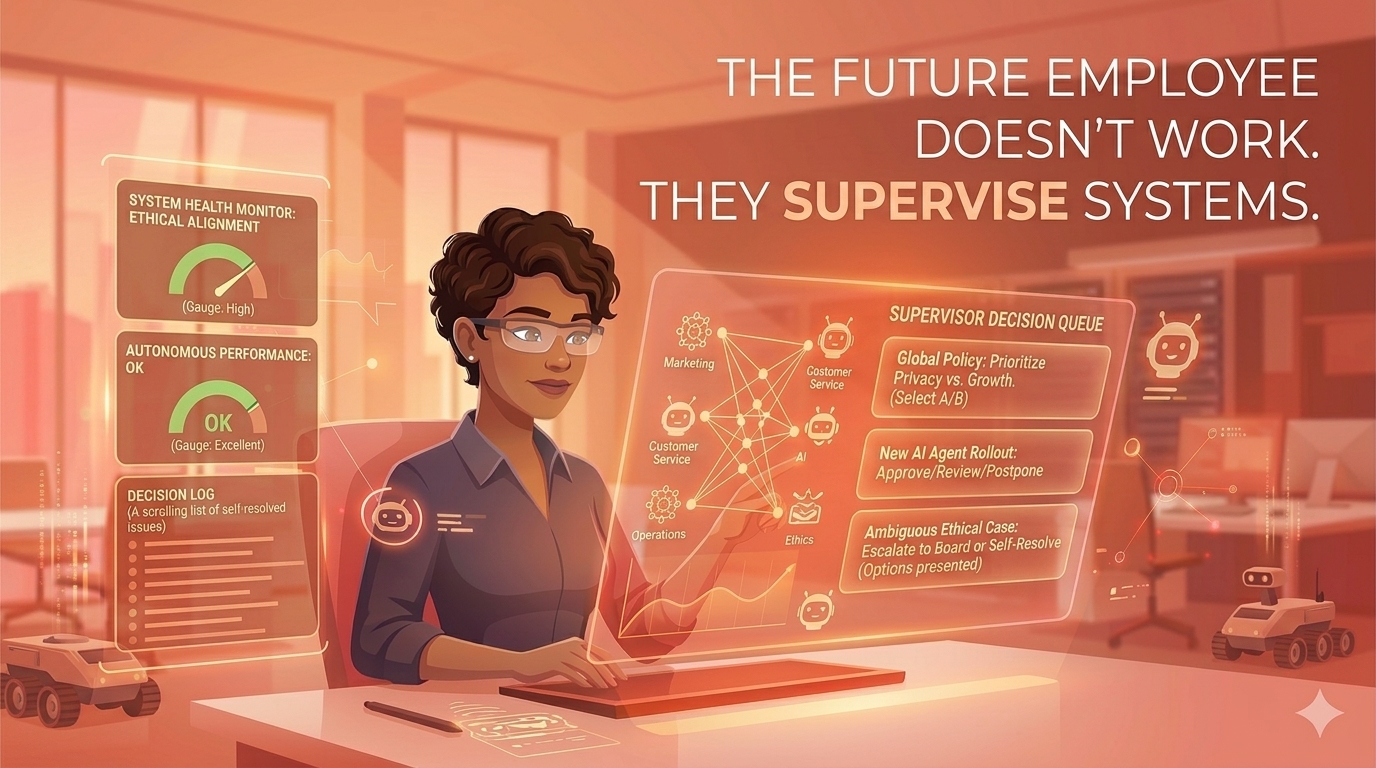
This is the real transformation. Employees are no longer valuable only because they can do tasks. They are valuable because they can direct, review, and improve execution. Instead of spending their time typing, chasing, and manually moving work forward, they oversee the systems doing those things for them.
That changes the role entirely. The employee becomes the supervisor of outputs, the manager of exceptions, and the decision-maker where context still matters. This shift is not about removing people from the business. It is about repositioning people where they create the most value.
The old model said humans execute and systems support. The new model says systems execute and humans supervise. That is a major operating change, and it is why AI is reshaping what a job actually is.
What AI Employees Actually Are
This is where businesses need a more precise definition. AI employees are not just chatbots, and they are not random automations stitched together without a role. They are role-based digital workers designed to operate inside a defined workflow.
An AI Voice Rep can answer and qualify leads. An AI Engagement Rep can follow up consistently without delays. An AI Operations Assistant can keep processes moving behind the scenes. These systems do not simply assist occasionally. They carry execution responsibilities within the operating model.
That is what makes them different. They are not side tools. They are execution layers. This shift is closely connected to what STA explores in how companies are replacing outdated processes instead of just cutting costs, because real AI transformation is not about trimming around the edges. It is about rethinking how work gets done in the first place.
A Practical Framework for Implementing This Model
Businesses do not make this transition by installing software and hoping for the best. They need a practical AI implementation framework that connects workflow design with role-based execution.
Identify workflow friction
Find the repetitive, delay-heavy, admin-heavy work that consumes team capacity and slows down execution.
Redesign the workflow
Remove unnecessary steps, clarify handoffs, and simplify the path from input to outcome before automating anything.
Assign AI execution roles
Define where AI should take over work entirely and where it should support the process under human oversight.
Keep humans in supervisory positions
Position your team around review, decisions, approvals, and exception handling rather than repetitive execution.
This framework matters because too many businesses jump directly from curiosity to tool usage. That creates movement, but not operating change. Real transformation happens when AI becomes part of the workflow architecture, not just another app on the stack.
Why This Changes the Economics of Growth
When businesses redesign work this way, the impact goes beyond productivity. They change the economics of scale. Instead of hiring more people every time demand increases, they increase capacity by embedding AI into execution layers that previously depended on manual effort.
- Operations move faster because execution happens continuously.
- Teams reduce manual work and reclaim time for better decisions.
- Small teams can outperform larger ones because systems carry more of the operational load.
- Consistency improves because processes stop depending on memory and manual follow-through.
That is the real promise of AI in business. Not just speed. Not just convenience. A better operating model. As highlighted in McKinsey’s research on the economic impact of generative AI on operations, companies that redesign workflows around AI stand to unlock significant productivity gains and cost efficiencies.
Conclusion: The Future Employee Is Already Here
The question is no longer whether AI will change work. It already is. The more important question is whether businesses will redesign around that reality or continue forcing people to do work that systems should already be doing.
The future employee does not create value by pushing every task forward manually. They create value by supervising systems, reviewing outputs, making decisions, and improving how execution happens across the business. That is how companies scale without adding unnecessary headcount. That is how lean teams move faster. And that is how modern operations become more resilient.
Final Takeaway
The future employee does not work in the old sense of the word. They supervise systems that do the work. Businesses that understand this early will build faster, cleaner, and more scalable operations than those still relying on task-heavy manual workflows.