
Wilton Rogers
March 13, 2026
A practical framework for companies that want to move beyond scattered AI experiments and build real operational transformation through smarter workflow design and structured AI implementation.
Artificial intelligence is rapidly becoming part of everyday business conversations. Companies across industries are experimenting with AI tools to write content, analyze data, automate emails, assist customer support, and improve productivity. From startups to large enterprises, leaders are beginning to see how AI can remove repetitive work, accelerate decision making, and help teams operate more efficiently across multiple departments.
However, simply adding AI tools does not automatically transform a business. When AI is introduced without a clear strategy, it often creates fragmented systems and operational complexity. Teams may begin using different tools that do not communicate with each other, processes remain manual behind the scenes, and organizations struggle to see measurable results. Without a structured implementation approach, AI becomes a collection of experiments instead of a true operational advantage.
AI works best when it starts in areas where workflows are repetitive, measurable, and slowing the organization down, which is why many companies first explore how digital workers are transforming modern business operations and reducing manual workloads before expanding AI into other departments.
Many organizations begin AI adoption by experimenting with tools across departments. Marketing teams may start using AI content generation tools, sales teams test AI assistants to help with outreach, and customer support groups deploy chatbots to handle incoming requests. While these initiatives are often well intentioned, they usually happen independently rather than as part of a coordinated strategy.
These experiments often create disconnected systems instead of true transformation. When different teams implement AI separately, the underlying workflows of the business remain unchanged. Information still needs to be moved manually between systems, approvals continue to slow down processes, and employees spend valuable time coordinating tasks instead of focusing on strategic work.
Operational friction usually appears in everyday processes handled manually by employees. These are the small tasks that rarely attract attention but quietly consume hours of time every week. Over time, these repetitive actions accumulate and create hidden bottlenecks that limit how quickly the business can respond, scale, and operate.
When these tasks occur hundreds or thousands of times each week, they create major slowdowns across the organization. Teams may feel constantly busy, yet progress across projects remains slower than expected. This type of friction often signals that workflows need redesign rather than simply adding more employees to handle the workload, a challenge discussed in detail when examining why hiring digital workers instead of continuously expanding staff can remove operational bottlenecks.
Successful companies usually follow a structured process when implementing AI. Instead of deploying tools randomly, they evaluate how work flows across the organization and identify the areas where automation and AI can deliver the most meaningful impact. This structured approach ensures that each step of AI adoption improves operational efficiency rather than adding complexity.
Map where work slows down, where delays repeat, and where manual coordination is creating friction across the business.
Start with recurring tasks that follow clear rules so AI and automation can remove manual effort quickly and cleanly.
Connect AI into the actual flow of work so systems, teams, and data move together instead of operating in silos.
Create an operating model where AI supports execution, visibility, and decision-making across the organization, similar to how modern companies are structuring AI employees into coordinated digital workforce systems that support scalable operations.
Traditional growth often requires hiring more employees to manage increasing workloads. As businesses expand, additional staff are brought in to process information, coordinate tasks, and manage operational activities. While hiring remains important, relying solely on workforce expansion can introduce additional layers of communication and coordination that slow down decision making.
AI allows companies to scale differently by building intelligent systems that move work automatically and support decision making. Instead of depending entirely on manual coordination, organizations can design workflows where information moves between systems, routine tasks are handled automatically, and teams receive insights that help them act faster. This shift allows businesses to grow without the same level of operational complexity that traditionally accompanies expansion. Industry research also shows that organizations implementing structured AI strategies see significantly higher productivity gains, as highlighted in McKinsey research on enterprise AI adoption and value creation.
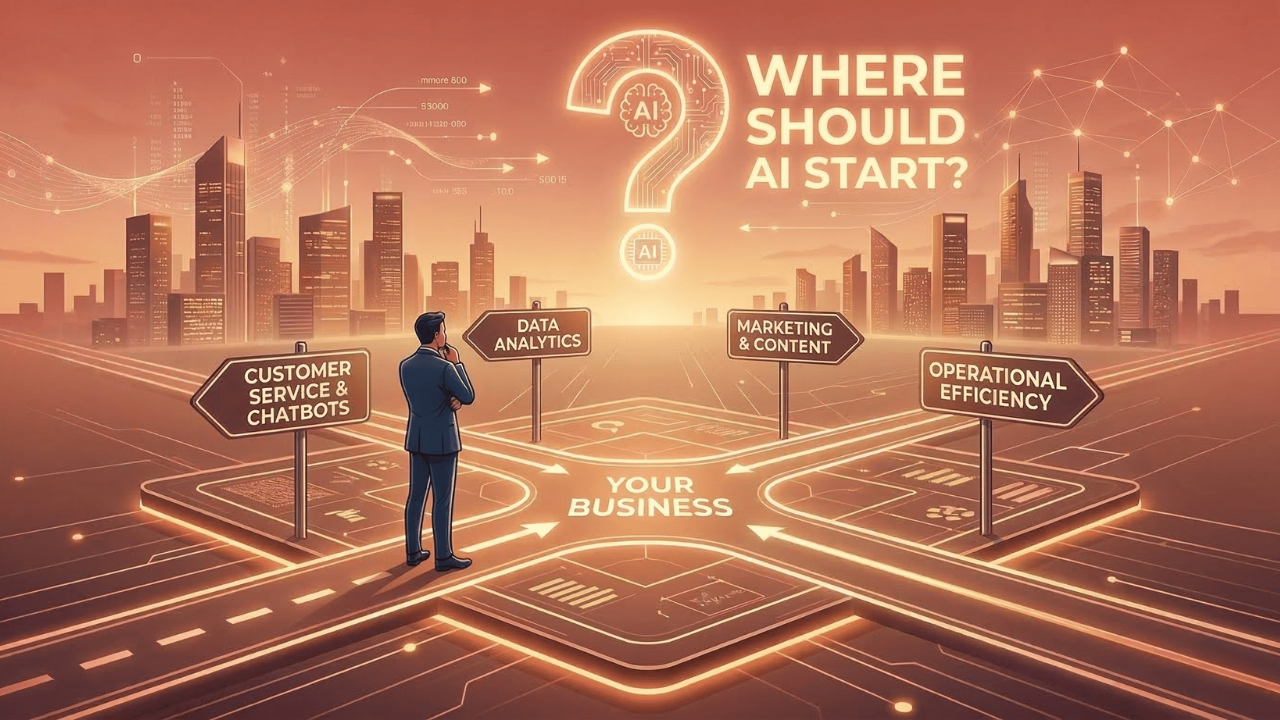
Do not start AI where it looks the most exciting or where the newest tools appear first. The strongest results usually come from starting where your business is losing the most time, coordination, and operational momentum.
Look for processes where employees repeatedly move information between systems, where approvals slow down execution, or where teams spend hours managing tasks that follow predictable rules. These areas represent the highest leverage opportunities for automation.
When AI is introduced in these friction-heavy workflows, the impact becomes immediately visible. Teams experience fewer delays, information moves faster across systems, and employees can redirect their attention toward strategic work rather than repetitive coordination.
In other words, successful AI adoption is not about chasing tools. It is about redesigning how work flows through the business. Start where the friction is highest, build intelligent workflows around those processes, and allow AI to gradually expand across the organization from that operational foundation.
See how businesses are implementing AI systems that reduce manual work and improve operational efficiency.
Explore ResourcesLet us show you exactly where to start.
👉 Schedule a Free Automation Assessment
Welcome!
Meet your team of 24/7 AI Assistants. Each built to help your business run smarter and faster. Choose how you’d like to connect:
Call Mira - Your AI-Powered Voice Assistant
Reach out to Mira anytime at (817) 809-3820
for instant support and to see how AI and automation can transform...
your business. Mira can walk you through our services, answer questions, and even schedule a demo - all in real time.
Read more..
Talk Live with Nova - Your Online AI Voice Agent
Want a real conversation right here online? Nova can speak with you directly through your browser. No downloads...
, no wait times. Ask about automation, AI Employees, or how STA can streamline your operations. Nova is standing by for a one-on-one chat right now.
Read more..
Chat Instantly with Seren - Your AI Conversation Partner
Prefer to text? Seren is your instant connection for quick answers, resources, or a guided walkthrough of how we help businesses...
like yours automate and scale. Type your question and Seren will reply in real time.
Read more..
© 2026 ScaleThroughAutomation, All right reserved.