
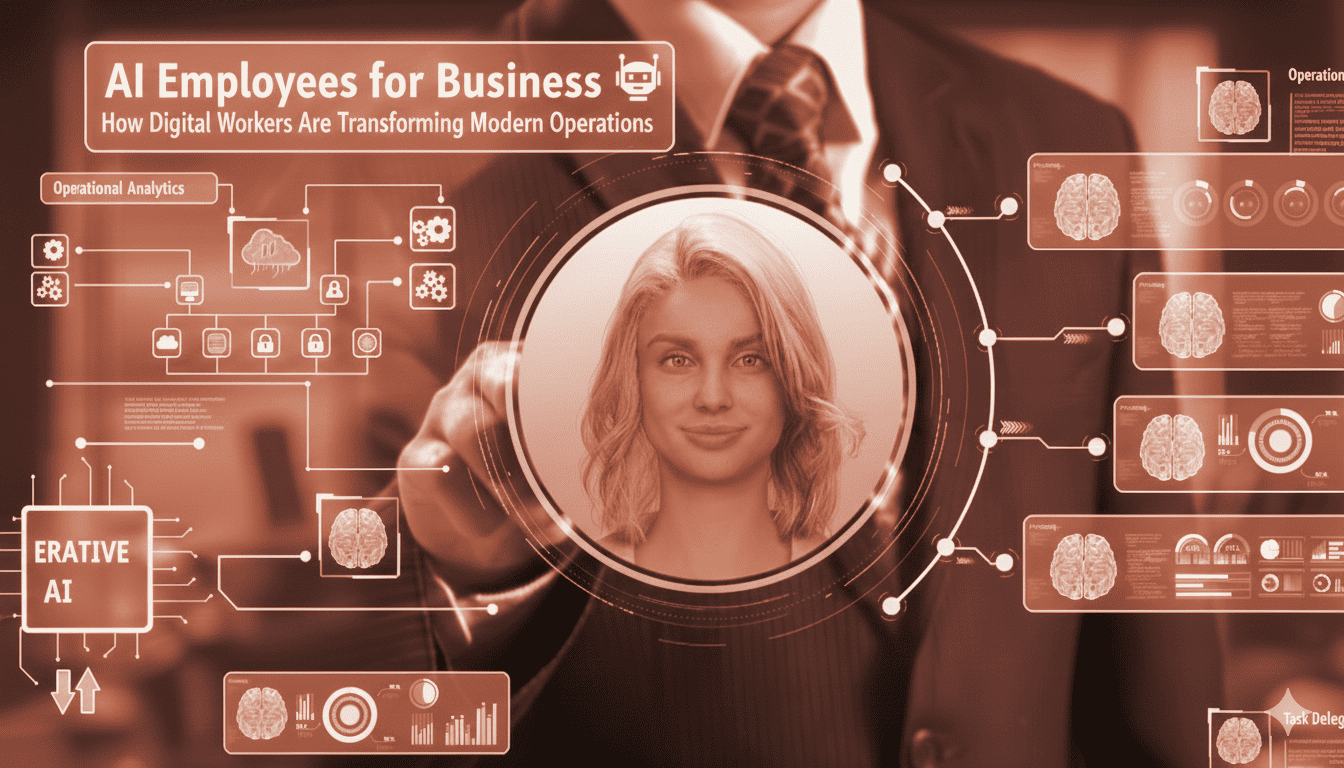
Across industries, leaders are discovering a new operating model. One where repetitive tasks, follow-ups, coordination, and workflows are handled by digital workers designed to run alongside human teams.
These are AI employees. Not tools. Not chatbots. Not automation scripts. But role-based digital coworkers that execute operational work with speed, consistency, and scale.
What AI Employees Mean for Modern Businesses
For decades, growth meant hiring more people. More staff to manage leads. More admins to coordinate schedules. More managers to oversee processes. But this model creates operational drag. More people introduce more handoffs, more communication gaps, and more complexity.
AI employees change the equation. Instead of scaling through headcount, businesses can now scale through systems. Digital workers handle structured tasks while human teams focus on strategy, relationships, and decision-making.
Why Businesses Are Moving Beyond Automation Tools
Traditional automation tools helped reduce manual work, but they still required constant management. Businesses needed someone to monitor workflows, fix errors, update processes, and manage integrations.
AI employees go further. They do not just automate steps. They execute roles. They can follow up with leads, route tasks, update systems, coordinate workflows, communicate with customers, and generate reports.
How AI Employees Fit Into Business Operations
Every business runs on workflows. Leads to sales. Sales to fulfillment. Fulfillment to support. Support to retention. Retention to growth. AI employees integrate directly into these workflows to remove bottlenecks and maintain momentum.
Instead of relying on manual handoffs, digital workers ensure tasks move forward automatically and consistently. They act as the connective layer between your systems, ensuring nothing falls through the cracks.
Key Roles AI Employees Can Perform
AI employees are most effective when assigned clear operational roles.
- Lead follow-up specialist
- Scheduling coordinator
- Customer support assistant
- Workflow operations manager
- Reporting analyst
- Knowledge assistant
- CRM data manager
- Task routing coordinator
Each role mirrors responsibilities traditionally handled by human staff, but without the limitations of time, fatigue, or inconsistency.
Benefits Across Industries
Businesses across sectors are adopting digital workers because the impact is measurable.
- Increased speed: tasks that once took hours happen instantly.
- Greater consistency: processes run the same way every time.
- Lower operational costs: less reliance on manual admin work.
- Improved customer experience: faster responses and fewer delays.
- Better team focus: employees focus on high-value work instead of repetitive tasks.
These benefits compound over time, creating stronger and more resilient operations.
The Role of Training in Building Effective AI Employees
Technology alone does not create results. The real power comes from how well AI employees are trained to understand your workflows, decision rules, and business logic.
Proper AI employee training ensures digital workers operate accurately, consistently, and reliably across your systems.
When Businesses Add Digital Workers
Most companies begin exploring AI employees when operational friction starts slowing growth. Common triggers include increasing administrative workload, slow follow-up processes, missed opportunities, disconnected systems, rising payroll costs, and team burnout.
At this stage, many leaders begin looking into whether to hire an ai employee instead of expanding headcount, recognizing that systems often scale more effectively than staff alone.
Common Misconceptions
- Myth: AI replaces people. Reality: AI removes repetitive work so people can focus on strategic tasks.
- Myth: AI is only for large companies. Reality: small and mid-sized businesses often benefit the most.
- Myth: AI is complicated to implement. Reality: with the right framework, AI employees integrate smoothly.
- Myth: AI is just automation. Reality: AI employees are role-based digital workers, not simple task automation.
How Businesses Transition to a Digital Workforce
Transitioning to AI employees does not require rebuilding your company from scratch. The process typically includes:
- Identifying repetitive workflows
- Mapping operational processes
- Defining roles for digital workers
- Training AI on business logic
- Integrating systems
- Monitoring and optimizing
Companies that follow this structured approach see faster adoption and stronger results.
The Future of AI Employees in Business
The way businesses operate is changing. In the near future, companies will not measure growth by headcount alone. They will measure how effectively their digital workforce supports operations.
Businesses that adopt AI employees early gain a competitive advantage through speed, efficiency, and scalability. Those that delay often struggle with rising operational complexity.
Final Thought
The evolution of business is not about replacing people. It is about removing friction. AI employees represent a new operational layer that allows businesses to scale intelligently, operate efficiently, and grow sustainably.
The question is no longer whether AI will become part of business operations. It is how quickly you choose to adapt.