
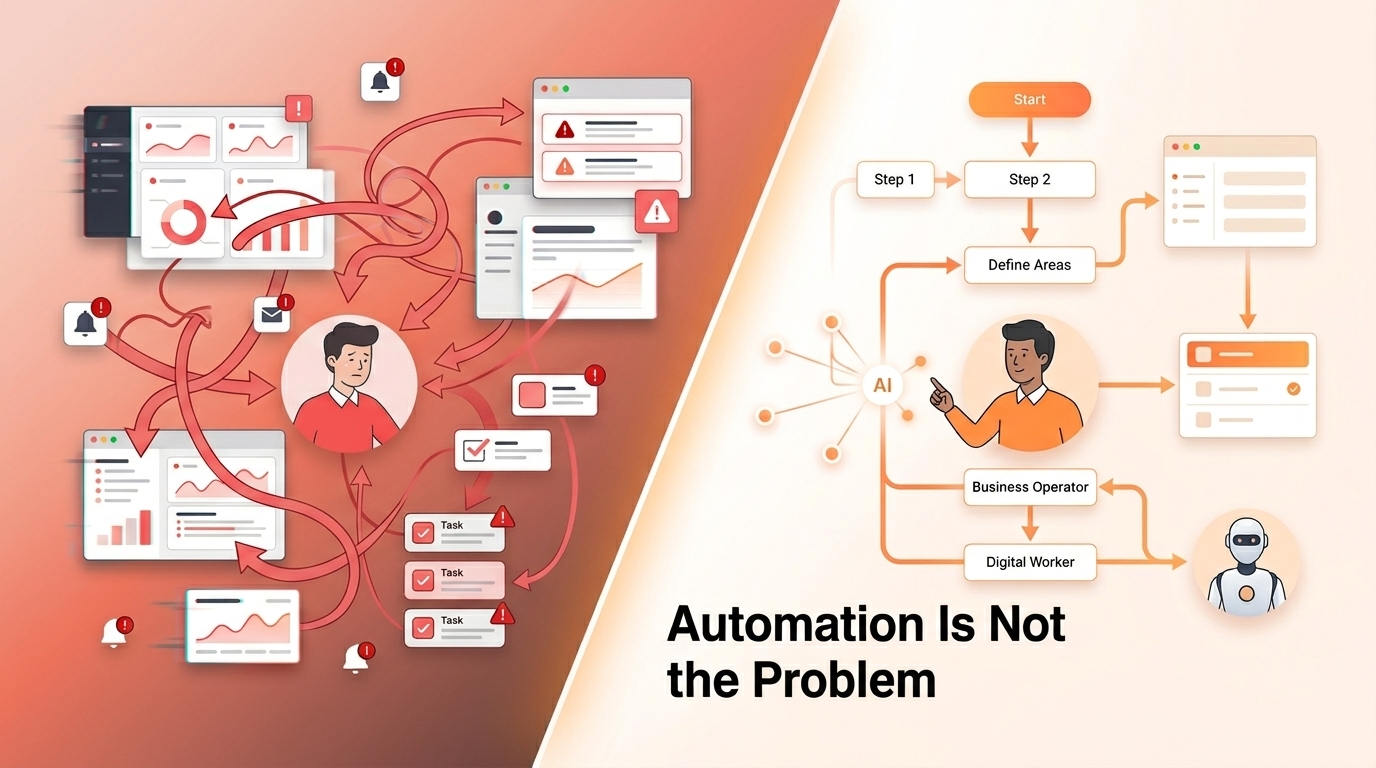
Most businesses believe automation is the answer to operational inefficiency. They expect it to create speed, reduce workload, and help the business scale. But many automation initiatives lead to the opposite outcome. Teams stay overwhelmed, processes remain messy, and the business still feels harder to run than it should.
The problem is rarely the software itself. It is the assumption behind the implementation. Businesses often automate activity before they create structure. They connect systems before clarifying workflows. They add automation on top of confusion and expect it to create control.
That is where things go wrong.
The Biggest Misconception About Automation
Automation is often treated like a shortcut to efficiency. Many businesses miss the foundational step explained in how to decide where AI should start in your business operations before implementing tools. The logic sounds reasonable. If people are overloaded, then technology should remove the pressure. If the team is slow, then automating tasks should create momentum.
But automation is not a fixer. It is an amplifier. This aligns with findings from research on how automation amplifies existing operational systems rather than correcting them. It multiplies whatever operational structure already exists inside the business. If that structure is clear and well-designed, automation creates speed and consistency. If that structure is messy, unclear, or dependent on memory, automation increases the mess faster.
Core Principle
Automation does not correct broken workflows. It scales them. That is why a tool-first approach creates frustration while a system-first approach creates operational leverage.
Why Automation Projects Fail
Most automation projects fail because businesses automate before understanding how work actually happens. They move too quickly into implementation without mapping the real flow of operations. The result is predictable. Tools get layered onto fragmented processes, team members still fill in the gaps manually, and leadership starts wondering why the promised efficiency never arrived.
This usually shows up in familiar ways. Follow-ups are inconsistent. Tasks are duplicated. Handoffs between people are unclear. Important steps live in someone’s head instead of inside a documented process. Then automation gets introduced on top of that weak structure.
At that point, the business does not become more efficient. It becomes faster at repeating the same operational problems.
The Hidden Problem: Broken Workflows
Every business runs on workflows whether they are documented or not. A lead comes in, someone responds, information gets collected, a next step is triggered, and the opportunity moves toward conversion. The same pattern exists in onboarding, service delivery, operations, reporting, and client communication.
When those workflows are not intentionally designed, work becomes reactive. People rely on memory. Tasks get handled differently depending on who is available. Delays become normal. Quality becomes inconsistent.
Broken workflows often create the same symptoms across different businesses:
- Missed or delayed follow-ups
- Repeated manual tasks that should be standardized
- Unclear handoffs between team members
- Inconsistent customer experiences
- Leaders staying trapped inside day-to-day operations
These are not just workflow issues. They are scale limitations. A business cannot grow cleanly when the underlying operational flow is unstable.
Why Automation Amplifies Problems
Automation increases speed. That sounds positive until speed is applied to the wrong process. If the workflow includes unnecessary steps, weak decision points, or missing accountability, automation accelerates all of it. Instead of solving operational friction, it hardwires that friction into the system.
That is why some businesses feel even busier after investing in automation. Notifications increase. Data moves faster, but still to the wrong place. Tasks fire in sequence, but the sequence itself is poorly designed. More activity is happening, but the business still does not feel simpler or more scalable.
The real issue is not effort. It is structure. Businesses that treat automation as a strategic layer rather than a magic fix get very different results.
The System-First Automation Framework
A system-first approach means automation follows a clear operational design. Instead of asking what tool to buy first, the better question is this: how should work move through the business if it were designed for scale?
Map the workflow
Identify how work actually moves from start to finish. This includes triggers, handoffs, decisions, delays, and outcomes. Do not map the ideal version only. Map the real version first.
Identify friction
Look for delays, repeated tasks, weak handoffs, and places where people rely on memory instead of process. These points reveal where the workflow is breaking down.
Simplify the process
Remove unnecessary steps. Standardize actions. Clarify ownership. Complexity kills automation because complex processes create too many exceptions to manage well.
Introduce automation
Once the workflow is clean, automation can be added in a way that supports the structure. This creates consistency, reduces manual work, and makes scaling more sustainable.
How to Implement Automation the Right Way
Successful automation comes from operational clarity. That means documenting how the business should run, defining what a completed process looks like, and reducing the need for team members to improvise each time work shows up.
In practical terms, this means leaders should focus on building repeatable systems before layering in technology. Processes should be visible. Ownership should be clear. Decision logic should be documented. Manual work should be reduced intentionally, not randomly.
This is where a real business automation strategy becomes valuable. It helps a company move beyond isolated automations and toward a consistent operating model built for efficiency.
The Role of AI Employees in Scalable Systems
Once a workflow is structured properly, AI becomes far more useful. Instead of acting like a disconnected assistant, it can operate inside a defined role. That is where AI Employees create meaningful business value. This aligns with the broader shift discussed in how digital workers are transforming modern business operations and why role-based automation is replacing task-based thinking.
At Scale Through Automation, we approach AI through the lens of workflow execution. We do not begin with random tools. We begin with how the business should operate, then introduce digital workers that can perform within that structure.
An AI Engagement Rep can respond to incoming leads instantly and consistently. An AI Operations Assistant can keep processes moving and reduce the need for manual oversight. An AI Voice Rep can manage calls with more consistency than an overloaded front desk or fragmented call flow.
This is not about replacing people with hype-driven technology. It is about removing manual work from the wrong parts of the business so human teams can focus on judgment, relationships, and higher-value decisions.
Business Impact of System-First Automation
When automation follows a well-designed system, the effect is bigger than speed alone. Businesses reduce manual work, improve consistency, create better customer experiences, and gain more visibility into how operations actually perform.
That creates a different kind of scale. Instead of growing by adding pressure, the business grows by increasing operational capacity. Teams spend less time chasing routine work and more time focusing on growth, service quality, and strategic priorities.
This is the real promise of automation when it is done properly. Not just faster activity, but stronger operations. Studies like how AI is redefining management and operational performance show that structured systems are what unlock real gains from automation.
Conclusion
Automation is not the enemy. But the wrong approach to automation is one of the biggest reasons businesses stay stuck. When companies automate broken workflows, they scale confusion. When they redesign operations first, automation becomes a multiplier for efficiency and growth.
The shift is simple but powerful. Stop asking what to automate first. Start by asking how work should actually flow inside the business. Once that is clear, automation can do what it is meant to do.
Before you automate anything, ask one question: do you have a system, or do you just have activity? Activity keeps teams busy. Systems help businesses scale. The future of business is not more tools. It is better systems powered by AI Employees.