
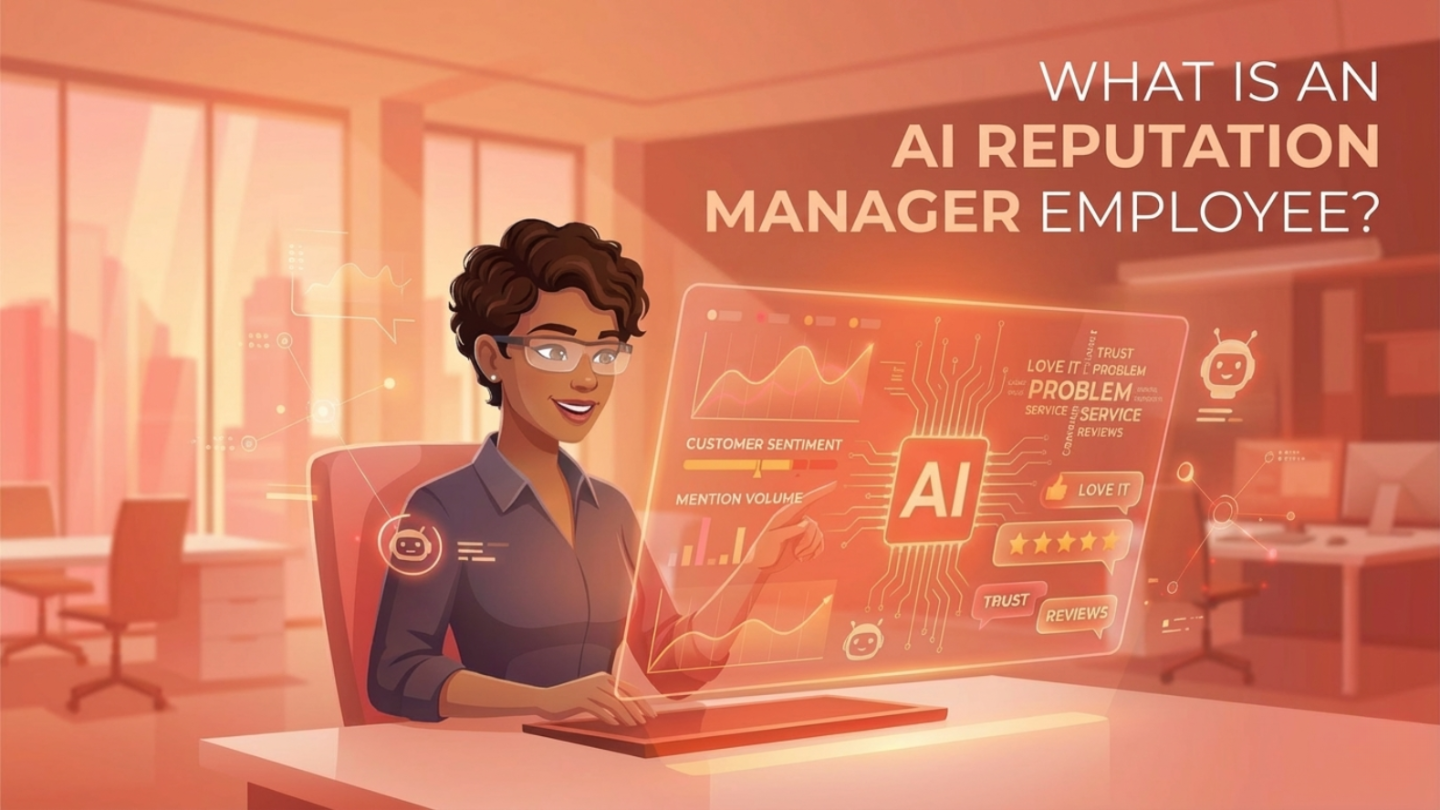
What Is an AI Reputation Manager Employee?
For most businesses, reputation management is still handled as a reactive task. Someone checks reviews when they remember. Responses are written when there is time. Negative feedback is escalated too late. Review requests happen inconsistently, if they happen at all. The result is a workflow that directly affects trust and growth, yet often operates without structure.
That is exactly where an AI reputation manager employee changes the equation. Instead of treating reputation management as a loose collection of manual tasks, it turns it into a fully designed operating function. It becomes something the business runs continuously rather than something the team tries to catch up on.
An AI reputation manager employee is a role-based digital worker built to monitor reviews, respond to feedback, request new reviews, flag risks, and strengthen brand perception across digital channels. It is not simply a smart assistant layered on top of existing work. It is a system designed to take ownership of the workflow itself.
An AI reputation manager employee doesn’t assist your team. It replaces the manual workflow entirely. That means the business is no longer dependent on human availability to maintain review quality, response speed, and customer perception.
The Problem with Traditional Reputation Management
Most companies do not have a real reputation management system. What they have is a scattered process. A front desk employee might check Google reviews from time to time. A marketing person may draft responses when a complaint escalates. A manager might ask happy customers for reviews, but only when they remember. This creates inconsistency at every step.
The problem is not that people do not care about reputation. The problem is that the workflow is weak. It depends on memory, available time, and manual effort. As soon as the business gets busy, reputation management gets pushed aside.
- Reviews sit unanswered for too long
- Negative sentiment is discovered after it spreads
- Happy customers are not systematically prompted to leave feedback
- Brand voice changes depending on who replies
- No one has a clear view of review patterns and customer sentiment over time
In other words, the business ends up with exposure but no operational control. That is risky in a market where customers often trust public reviews before they ever speak to your team. In fact, research consistently shows the growing influence of online perception on buying decisions, as highlighted in how the modern customer decision journey is shaped by digital touchpoints.
What an AI Reputation Manager Employee Actually Is
An AI reputation manager employee is a digital worker assigned to the reputation management function inside a business. It is structured like an operator, not like a passive software tool. Its job is to execute the end-to-end process that shapes how the company is perceived online.
At a practical level, this digital worker can continuously monitor review platforms, identify sentiment, generate responses aligned with your brand, trigger review requests after key customer interactions, escalate high-risk situations, and surface patterns that leadership can act on. It is not waiting for someone to open a dashboard and tell it what to do. It is running the process by design.
This distinction matters because many businesses think they have automated reputation management when they have only purchased software. The interface may look modern, but the workflow is still manual. A true AI reputation manager employee takes the work itself off the team’s plate. That same shift becomes easier to understand when you look at how digital workers transform modern business operations beyond isolated tools and dashboards.
Why Most Businesses Misunderstand Reputation Automation
One of the biggest misconceptions in automation is believing that better tools automatically create better systems. They do not. Tools can improve visibility, centralize information, and make manual tasks easier, but that is still very different from redesigning the workflow.
Most businesses approach reputation automation by asking how technology can help their staff respond faster. That is still a support mindset. The more strategic question is how the entire reputation workflow can run with minimal or no manual involvement in the first place.
This is where the language of digital workers becomes useful. When you think in terms of an AI employee, you stop asking what feature to add. You start asking what responsibility should be owned by the system. That shift moves automation from convenience into operations. It also aligns closely with building human and AI into the same workflow model rather than treating AI as a disconnected add-on.
How an AI Reputation Manager Employee Works
An AI reputation manager employee operates as a continuous loop inside the business. It observes, interprets, acts, and escalates. The goal is not just faster responses. The goal is full workflow coverage so that no part of the reputation process depends on chance.
Monitors reviews across platforms
The system continuously watches Google, Yelp, Facebook, industry directories, and other relevant channels so new feedback is identified immediately instead of days later.
Responds automatically and consistently
It generates context-aware responses using approved tone, service logic, and escalation rules so the business sounds consistent across every public interaction.
Requests new reviews at the right time
It can trigger review requests after successful service delivery, positive conversations, completed appointments, or other high-satisfaction moments.
Flags risk before it compounds
Low ratings, recurring complaints, or sensitive issues can be routed for human review immediately so the team can intervene where judgment is required.
Beyond these visible actions, the AI employee can also structure feedback into operational insight. Instead of seeing reviews as isolated comments, leadership can view them as data points tied to service quality, responsiveness, process failures, and customer experience friction.
The Shift from Tool Usage to Workflow Ownership
The reason this matters is simple. Reputation management is not one task. It is a chain of connected responsibilities. Monitoring alone is not enough. Responding alone is not enough. Asking for reviews alone is not enough. Value comes from the entire workflow operating reliably together.
That is why an AI reputation manager employee should be viewed as part of your operating system. It owns a role. It performs defined responsibilities. It follows decision logic. It escalates only when needed. And it creates a level of consistency that manual processes rarely maintain at scale.
When businesses adopt this model, they stop seeing reputation as something that must be chased. They start treating it like an always-on business function that directly supports growth, retention, and trust.
How to Implement It Strategically
Successful implementation starts with workflow design, not software selection. If the current process is unclear, inconsistent, or fragmented, adding AI on top of it will only create faster inconsistency. Businesses need to define what the system should own, what it should say, when it should escalate, and how performance should be measured. For businesses still deciding where to begin, this connects well with a practical framework for where AI should start inside the business first.
Map the current workflow
Identify how reviews are discovered, who responds, what channels matter most, and where delays or quality issues happen today.
Define brand voice and response rules
Clarify how positive, neutral, and negative reviews should be handled so the digital worker can operate within strong boundaries.
Design review request triggers
Choose the moments when satisfied customers should be invited to share feedback so review generation becomes systematic instead of accidental.
Set escalation paths
Determine what types of complaints, legal risks, or service failures should be routed to human leadership immediately.
Once those pieces are defined, the AI employee can be embedded as a working layer in the business. The goal is not simply to save time. The goal is to build a more reliable operating model around one of the most visible parts of the brand.
Business Impact of an AI Reputation Manager Employee
When this workflow is designed correctly, the impact extends beyond review responses. It affects trust, conversion, retention, and the internal workload of the team. Businesses become more responsive publicly without demanding more hours from staff privately.
Less manual work
Staff no longer need to manually check every review site, write repetitive replies, or remember to ask customers for feedback.
Stronger brand consistency
Responses follow a controlled tone and decision structure, which strengthens trust and improves the way the company is perceived over time.
Faster risk visibility
Negative trends, repeated service complaints, and customer frustration become visible earlier, allowing better operational correction.
More scalable reputation growth
Positive feedback generation becomes part of the workflow itself, helping the business strengthen its public credibility as it grows.
The deeper value is that the business no longer relies on heroic effort to look responsive and professional online. It builds a structure that delivers those outcomes by default. This aligns with broader findings on operational efficiency and automation, including insights from how AI adoption is reshaping business operations and performance across industries.
Conclusion
An AI reputation manager employee is not just another software category. It is a new way of assigning operational responsibility. Instead of asking people to manually monitor reviews, draft replies, request feedback, and catch risk, the workflow is transferred to a digital worker that runs continuously and consistently.
For businesses that depend on trust, perception, and customer confidence, this is not a minor improvement. It is an operational upgrade. Reputation stops being an afterthought and becomes a managed system.
Final Takeaway
If your business still manages reviews through scattered manual effort, you do not have a reputation system. You have a reputation task list. An AI reputation manager employee changes that by turning review management into a structured, always-on workflow that can actually scale.