
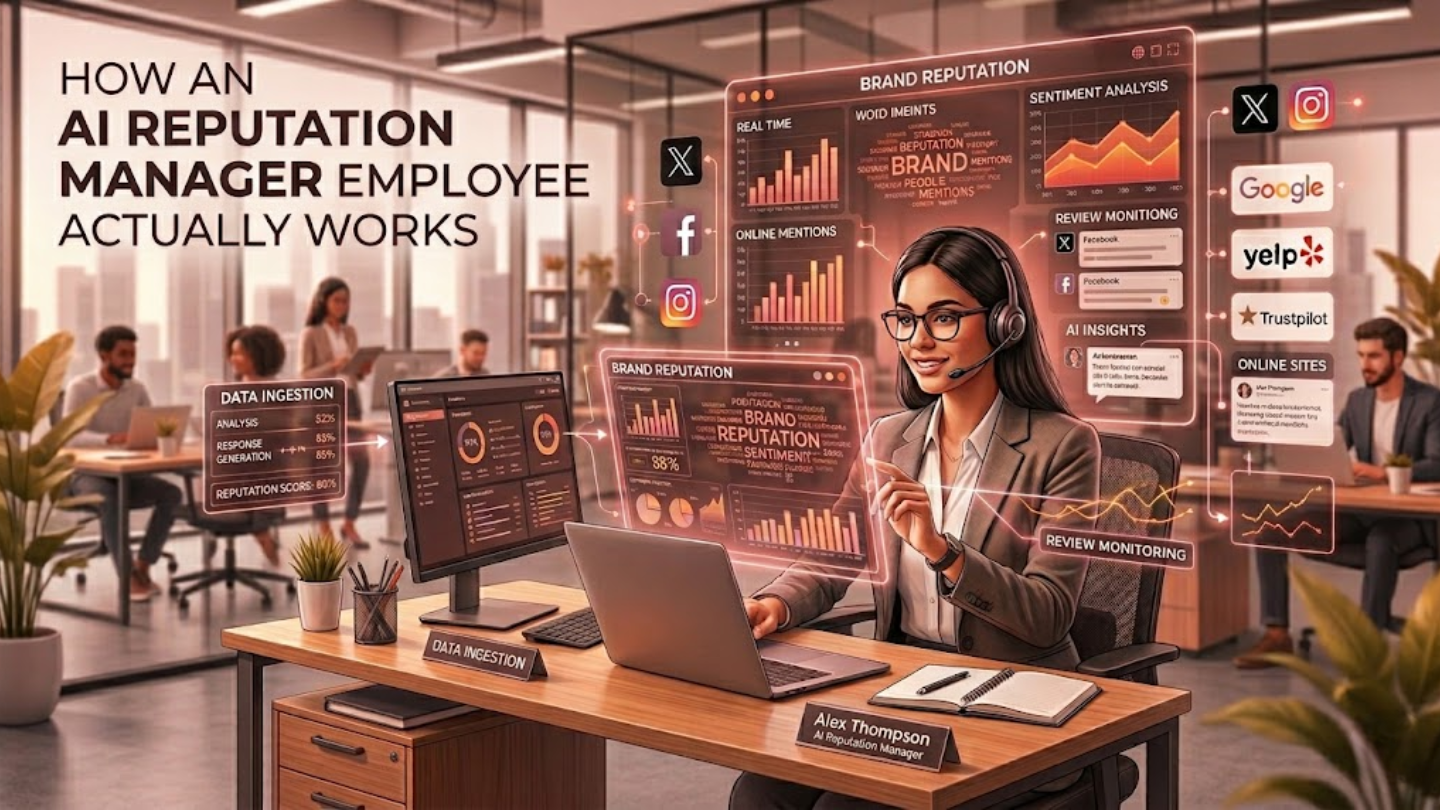
Most businesses think reputation management is about replying to reviews faster. That is only one small part of it. The bigger opportunity comes from building a system that continuously protects, improves, and scales public perception without relying on someone to manually check every platform, draft every reply, remember to ask for reviews, or catch a negative mention before it turns into a trust problem.
That is where an AI reputation manager employee becomes valuable. It fits into a broader shift toward how AI employees are redefining operational roles inside modern businesses. This is not just a chatbot, a dashboard, or a notification stream. It is a role-based digital worker designed to execute the reputation management workflow end to end. It watches channels, interprets feedback, responds in brand voice, generates review requests, and escalates risk the moment human judgment is needed.
An AI reputation manager employee does not assist your team with reputation management. It replaces the manual workflow entirely, while still routing sensitive cases to the right human when needed.
Why most businesses misunderstand reputation management automation
Many businesses assume automation means connecting a review tool, writing a few response templates, and letting generic replies go out. That may reduce some manual work, but it does not create a strong operating system for customer perception.
Real reputation management is not one action. It sits inside a larger system of how business process automation creates structured, repeatable workflows. It is a chain of actions. A business needs to know when a review appears, what it means, how urgent it is, how it should be answered, when to ask for more reviews, and when to escalate a serious issue before it grows into something larger. If any one of those steps breaks, the whole process becomes reactive.
An AI reputation manager employee matters because it connects all of those actions into one structured workflow. Instead of hoping a team member remembers to check platforms, reply on time, and follow up consistently, the digital worker executes the sequence with consistency.
What an AI reputation manager employee actually is
An AI reputation manager employee is a digital worker built to manage the operational flow behind online reputation. Its role is not simply to help a human work faster. Its role is to execute the function with consistency across channels.
That includes monitoring reviews and mentions, analyzing sentiment, drafting or sending on-brand responses, generating more reviews from satisfied customers, and instantly flagging high-risk cases. In other words, it gives the business a dedicated digital worker focused on protecting trust and improving public proof at scale.
Monitoring
Tracks reviews and mentions across the places customers actually talk about your business.
Sentiment analysis
Detects whether feedback is positive, negative, neutral, or urgent.
Automated responses
Generates personalized replies while keeping tone and messaging consistent.
Review generation
Requests more reviews through structured follow-up moments in the customer journey.
Escalation
Flags high-risk feedback instantly so the right human can step in fast.
Step 1: Monitoring
The first layer of the workflow is continuous monitoring. This is often where manual reputation management breaks down because reviews and mentions appear across different platforms, and most teams do not have the discipline or bandwidth to check them consistently.
An AI reputation manager employee monitors channels like Google reviews, Yelp, and social mentions in real time. Instead of waiting for someone to log in manually, search through platforms, and notice new activity hours later, the digital worker keeps watch continuously.
- Google reviews
- Yelp
- Social mentions
This matters because speed changes outcomes. A slow response to a negative review makes the business look inattentive. A missed positive review wastes an opportunity to reinforce trust publicly. A social mention that gets ignored can quietly shape perception without the business even realizing it.
Monitoring is not glamorous, but it is foundational. If a business cannot see what customers are saying as it happens, it cannot manage reputation strategically.
Step 2: Sentiment analysis
Once feedback is captured, the next step is interpretation. Not every review or mention should enter the same response path. Some comments are appreciative. Some are mildly disappointed. Others are emotionally charged or point to a deeper operational failure.
An AI reputation manager employee uses sentiment analysis to detect whether incoming feedback is positive, negative, neutral, or urgent. It is not only looking at star ratings. It is also evaluating tone, intent, wording, and context.
What this layer helps identify:
Positive feedback that should be reinforced, mild dissatisfaction that needs a calm reply, repeated complaints that suggest a systemic issue, and urgent language that needs immediate escalation.
This step matters because businesses do not just need faster responses. They need smarter prioritization. Without sentiment analysis, teams can easily overreact to small issues or underreact to serious ones. With it, the workflow routes attention where it matters most.
Step 3: Automated responses
After feedback is categorized, the AI reputation manager employee can move into response handling. This is where many businesses become skeptical because they assume automated replies will feel generic or robotic. That only happens when automation is poorly designed.
When built properly, response automation is guided by brand voice, tone rules, response logic, and context. That allows the AI employee to send personalized replies that still sound like the business.
- Personalized replies
- Brand voice consistency
For positive reviews, it can acknowledge the customer experience warmly and reinforce what was mentioned. For neutral or mildly negative feedback, it can recognize the concern and point to a next step. For more sensitive situations, it can pause the public workflow, send a safe reply, or hand the case off internally.
The value here is consistency and speed at the same time. Public perception is shaped not only by what customers say, but also by how the business responds in public. A structured AI workflow helps ensure those responses stay prompt, professional, and aligned with the brand.
Step 4: Review generation
Reputation management is not only about responding to feedback. It is also about creating a consistent flow of positive public proof. Many businesses deliver a good experience, but they do not have a reliable system for turning satisfied customers into visible reviews.
An AI reputation manager employee closes that gap by triggering review requests at the right moments in the customer journey. Instead of depending on staff to remember who to ask, when to ask, and how to follow up, the digital worker handles it as part of the workflow.
- SMS
- QR codes
That means review generation becomes proactive instead of accidental. After a positive service interaction, a completed project, or a successful support resolution, the workflow can automatically request feedback in a channel that fits the experience.
This is strategically important because stronger review volume does more than improve public proof. It also makes occasional negative feedback less dominant in how prospects perceive the brand.
Step 5: Escalation system
This is the part many businesses overlook. Not every issue should be handled fully through automation. Some situations require human judgment immediately, especially when feedback points to service failure, legal sensitivity, repeated complaints, or a serious customer experience breakdown.
A real AI reputation manager employee includes an escalation layer that flags bad reviews instantly and routes them to the right person. That might be a manager, owner, operations lead, or customer service lead depending on the structure of the business.
Automation becomes much more powerful when it knows its limits. The repeatable parts of the workflow stay automated, but the risky parts get surfaced fast so the business can respond with care and control.
Without escalation, automation can become risky. With escalation, automation becomes operationally mature because serious feedback is handled with the speed of a system and the judgment of a human.
Why this workflow matters operationally
The value of this workflow is not just that it saves time. It creates a reliable operating system around customer perception. Most businesses treat reputation management as a side task. Someone checks reviews when they remember. Someone else replies when they have time. Review requests happen inconsistently. Negative feedback gets discovered too late. Brand voice changes depending on who responds.
That is not a strategy. That is scattered manual effort.
An AI reputation manager employee changes that by making the process structured, repeatable, and scalable. This is exactly how human-AI hybrid teams are becoming the default model for modern operations. It reduces manual work, improves response speed, increases review volume, catches risks earlier, and helps the business maintain stronger trust signals in public.
Over time, this has real business impact. Better reputation management can influence lead conversion, customer confidence, local visibility, and long-term brand perception. According to research on how personalization and customer experience impact business performance, companies that respond effectively to customer signals see significantly stronger engagement and trust outcomes. More importantly, it removes a fragile workflow from busy staff and places it inside a system that runs continuously.
Conclusion
An AI reputation manager employee works by moving reputation management out of manual follow-up and into real workflow execution. It monitors channels, analyzes sentiment, responds in brand voice, generates new reviews, and escalates risk instantly.
The power is not in any single feature. It is in how each part works together as one coordinated system. When businesses approach reputation management this way, they stop reacting to public feedback and start managing trust with intention.
Final takeaway
The companies that get the most value from AI are not the ones collecting random tools. They are the ones turning critical business functions into structured digital workflows. An AI reputation manager employee is a strong example of that shift because it gives the business a dedicated digital worker that protects trust, amplifies positive customer experiences, and catches risk before it spreads.