Introduction
Texas has become one of the most active regions in the United States for AI adoption, workflow automation, and digital transformation. From Austin and Dallas to Houston and San Antonio, businesses are looking for ways to scale without adding unnecessary complexity, overhead, or operational drag.
That is changing how companies evaluate service partners. They are no longer just looking for software support or technical implementation. They are looking for partners who can help them rethink how work flows through the business, identify where manual effort is slowing down growth, and build systems that create real operational leverage.
This article highlights ten AI and automation companies with a presence or relevance in Texas, but it also does something more important. It helps you understand what kind of partner actually creates value. Because in practice, the best AI work does not start with a tool. It starts with a workflow problem, an operational bottleneck, or a scaling constraint that needs to be removed.
The Growing Demand for AI and Automation in Texas
Texas businesses are under pressure to grow faster while staying lean. That usually creates tension inside the business. Customer expectations rise. Internal communication gets heavier. Reporting becomes more fragmented. Teams spend more time chasing updates, handling repetitive tasks, and compensating for process gaps.
That is why interest in AI implementation companies and workflow automation services keeps rising across the state. Businesses are not just trying to save time. They are trying to create more reliable systems for execution.
Where the pressure usually shows up first
- Lead management and customer follow-up start falling through the cracks
- Internal handoffs become inconsistent and delay delivery
- Teams duplicate work because systems are disconnected
- Managers become bottlenecks for approvals, updates, and decision flow
AI and automation create value when they remove these sources of friction. That can include process orchestration, communication automation, operational tracking, AI-based support systems, and digital workers that keep tasks moving without waiting for someone to manually trigger the next step.
The Biggest Mistake Businesses Make When Choosing an AI Partner
The most common mistake is choosing based on tools instead of outcomes.
Businesses often ask whether a company can build a chatbot, connect a few apps, or deploy a model. Those may be useful capabilities, but they are not the same as solving an operational problem. If the underlying workflow is fragmented, adding AI into the middle of it can simply accelerate confusion.
That is why a strong AI partner should not begin with software. They should begin with questions about how work enters the business, how it moves across teams, where delays happen, where manual intervention is too high, and what growth is currently being constrained by inefficient execution.
What Makes a Strong AI and Automation Partner
The strongest firms do more than deliver implementation. They combine strategy, systems thinking, and execution. They understand that automation is not just about speed. It is about reliability, visibility, and scalability.
Workflow-first thinking
They analyze how work actually moves before recommending technology.
Manual work reduction
They target repetitive effort, bottlenecks, and dependency-heavy tasks.
Operational alignment
They connect AI initiatives to business goals, not isolated experiments.
Scalable system design
They build solutions that support future growth without creating more complexity.
These qualities matter because AI does not create value in a vacuum. It creates value when it becomes part of a repeatable, measurable, and well-designed business system.
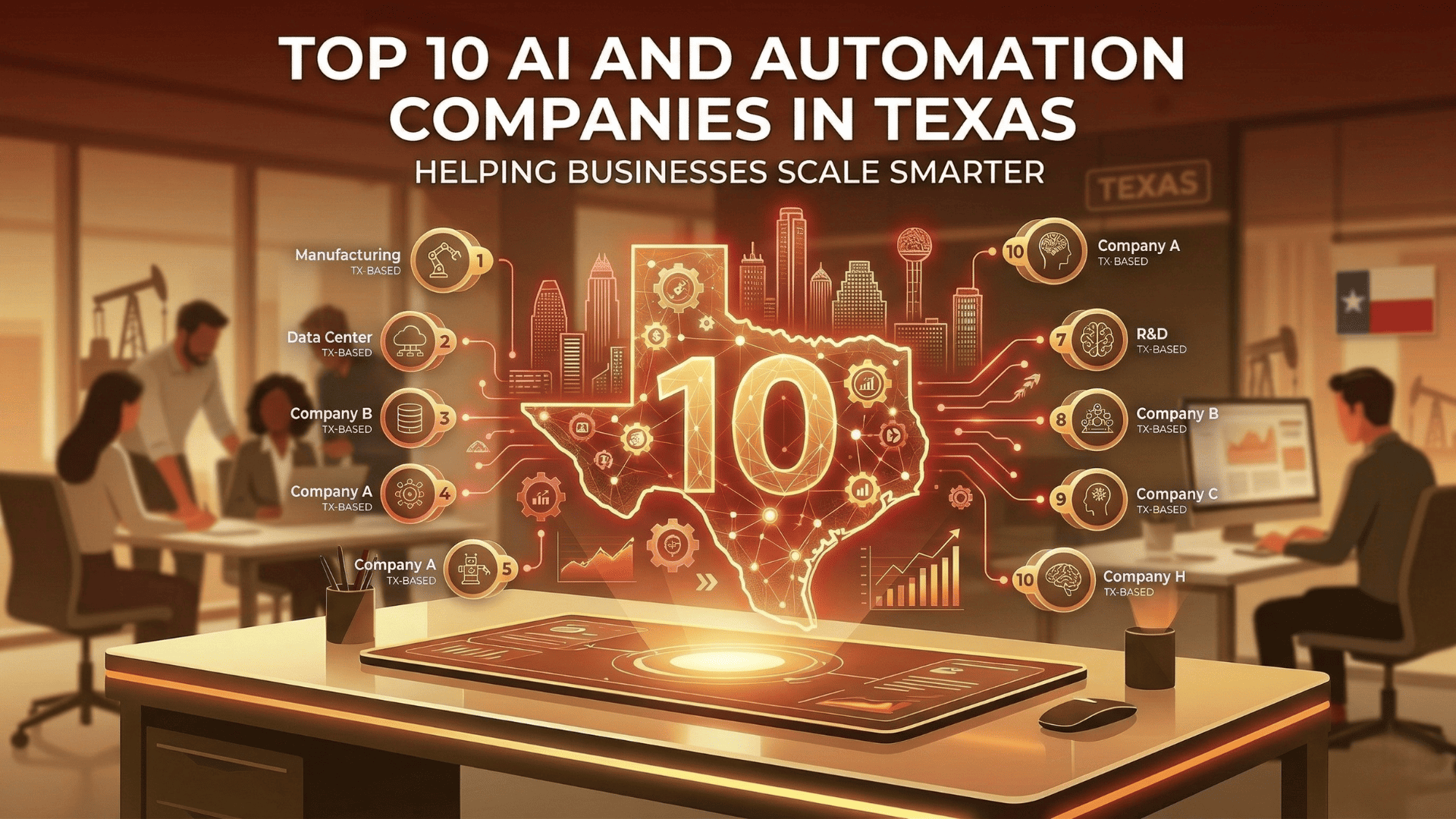
Top 10 AI and Automation Companies in Texas
The list below includes firms with different strengths, from enterprise transformation and industrial AI to workflow automation and operational system design. The right choice depends on your business size, budget, internal readiness, and the type of problem you are trying to solve.
1
scalethroughautomation.io
Scale Through Automation focuses on helping businesses redesign workflows and deploy AI employees, digital coworkers, and automation systems that operate inside real business processes. Rather than positioning AI as a collection of tools, STA approaches it as an operational design challenge.
This makes the company especially relevant for organizations that want to reduce manual work, improve execution flow, and build scalable systems without layering more complexity on top of already broken processes. Their positioning is more practical and workflow-centered than many firms that focus mainly on software implementation.
Build Smarter Operations With Scale Through Automation
If your business is growing but operations still depend too heavily on manual work, disconnected systems, or repetitive coordination, Scale Through Automation helps solve that at the workflow level. We design AI-powered operating systems, build digital coworkers that handle real tasks, and help businesses scale with more clarity, consistency, and leverage.
Explore Scale Through Automation
Accenture is one of the largest global consulting firms operating in the AI and automation space. For Texas businesses with enterprise-scale complexity, it brings strong capabilities in digital transformation, systems integration, cloud strategy, and AI-enabled operational modernization.
It is generally better suited to large organizations with significant budgets, multi-layered infrastructure, and long-term transformation agendas rather than smaller operators looking for focused workflow redesign.
Enterprise AI
Digital transformation
Systems integration
Deloitte combines strategy consulting, data capability, and enterprise implementation. It is especially relevant for companies in highly regulated sectors where governance, compliance, and large-scale change management matter alongside AI deployment.
Its strength lies in helping organizations build structured transformation programs, though the approach is typically enterprise-led and best matched to companies with formal internal transformation teams.
AI consulting
Compliance alignment
Enterprise operations
Cognizant is known for enterprise technology delivery, process transformation, and digital operations support. Its AI and automation work often sits inside larger modernization programs, making it a viable choice for businesses that need broad technical support across systems, operations, and IT architecture.
Process automation
IT modernization
Enterprise delivery
IBM brings deep expertise in enterprise AI, automation, analytics, and cloud infrastructure. It is often selected by large organizations that need strong data capability, AI platforms, security, and integration across core systems.
For businesses with mature internal teams and complex technical environments, IBM can be a strong fit, especially when the AI strategy depends heavily on data architecture and enterprise-grade reliability.
AI platforms
Cloud infrastructure
Advanced analytics
Slalom blends consulting and implementation with a reputation for aligning technology initiatives to business goals. For Texas businesses that want a more customized path into AI and automation, Slalom can provide a balance between strategy and execution.
Strategy + execution
Custom implementation
Business alignment
SparkCognition is one of the most recognizable Texas-based names in industrial AI. It is especially relevant in energy, manufacturing, and defense contexts where predictive analytics, asset intelligence, and operational monitoring matter.
Its work is less about general workflow automation for everyday business functions and more about AI applied to industrial and asset-heavy environments.
Industrial AI
Predictive analytics
Texas-based
Appinventiv is known for product development and custom application delivery, including AI-enabled solutions. Businesses looking to build customer-facing tools, custom apps, or product-driven automation experiences may find its approach useful.
Custom AI apps
Product development
Automation solutions
DataRobot focuses on AI lifecycle management, machine learning deployment, and predictive model scaling. It is a stronger fit for data-driven organizations that already understand the role of machine learning in forecasting, optimization, or decision support.
Machine learning
Predictive insights
Model deployment
SoftServe provides AI, digital engineering, and cloud modernization services. It can be a good fit for businesses that need scalable implementation support and broader digital transformation capacity tied to automation initiatives.
Cloud modernization
Digital engineering
Scalable implementation
How to Choose the Right Partner for Your Business
The right AI partner depends less on brand recognition and more on fit. A large enterprise transformation firm may be the wrong choice for a lean business that simply needs workflow redesign and operational system building. On the other hand, a specialized boutique may not be the right fit for a complex enterprise environment with layered compliance and infrastructure constraints.
When evaluating any AI consulting Texas provider or automation partner, ask whether they understand your workflows, whether they can identify operational bottlenecks, and whether their recommendations are tied to business outcomes like speed, reliability, capacity, or reduced manual effort.
Questions worth asking before you choose
- Where in our operation do you see the highest manual drag?
- How do you evaluate a workflow before automating it?
- What does success look like operationally after implementation?
- How will this scale as volume, team size, or customer demand increases?
The Future of AI-Driven Operations in Texas
Texas is well positioned to remain a major market for AI transformation. It has a strong mix of enterprise activity, startup energy, industrial infrastructure, and growth-focused mid-market businesses. That makes it fertile ground for both advanced AI initiatives and practical automation use cases.
The most important shift ahead is this: companies will stop thinking about AI as a separate layer and start building it directly into the operating model. That includes AI employees, digital coworkers, automated decision support, intelligent routing, proactive follow-up systems, and workflow orchestration that keeps work moving without constant manual intervention.
Less manual coordination
Teams spend less time chasing updates and more time on higher-value work.
Faster execution flow
Tasks move forward with fewer delays and fewer handoff failures.
Better visibility
Operations become easier to measure, manage, and improve over time.
More scalable growth
Businesses can absorb more volume without proportional overhead increases.
Ready to Build a Scalable AI-Driven Operation?
If you are serious about reducing manual work, eliminating operational bottlenecks, and building a system that can scale without constant oversight, this is where most businesses need the right partner. Scale Through Automation focuses on redesigning how your business operates, then embedding AI employees and automation directly into those workflows so execution becomes faster, more reliable, and easier to manage.
Instead of experimenting with disconnected tools, you get a structured approach to building a digital workforce that supports real growth.
Start Building Smarter Operations
Conclusion
The best AI and automation companies in Texas are not just technology vendors. They are partners in how a business scales. Some are built for enterprise transformation. Others are better aligned to workflow redesign, automation strategy, or operational improvement in more focused business environments.
The real opportunity is not simply to adopt AI. It is to design a smarter system for how your business runs. That means choosing a partner that understands operations, not just software.
Final Takeaway
Automation is not about doing the same work faster. It is about changing how work gets done so your business can operate with less friction, more consistency, and better scaling capacity. The companies that will benefit most from AI in Texas are the ones that treat it as an operational strategy, not a disconnected tech project.