
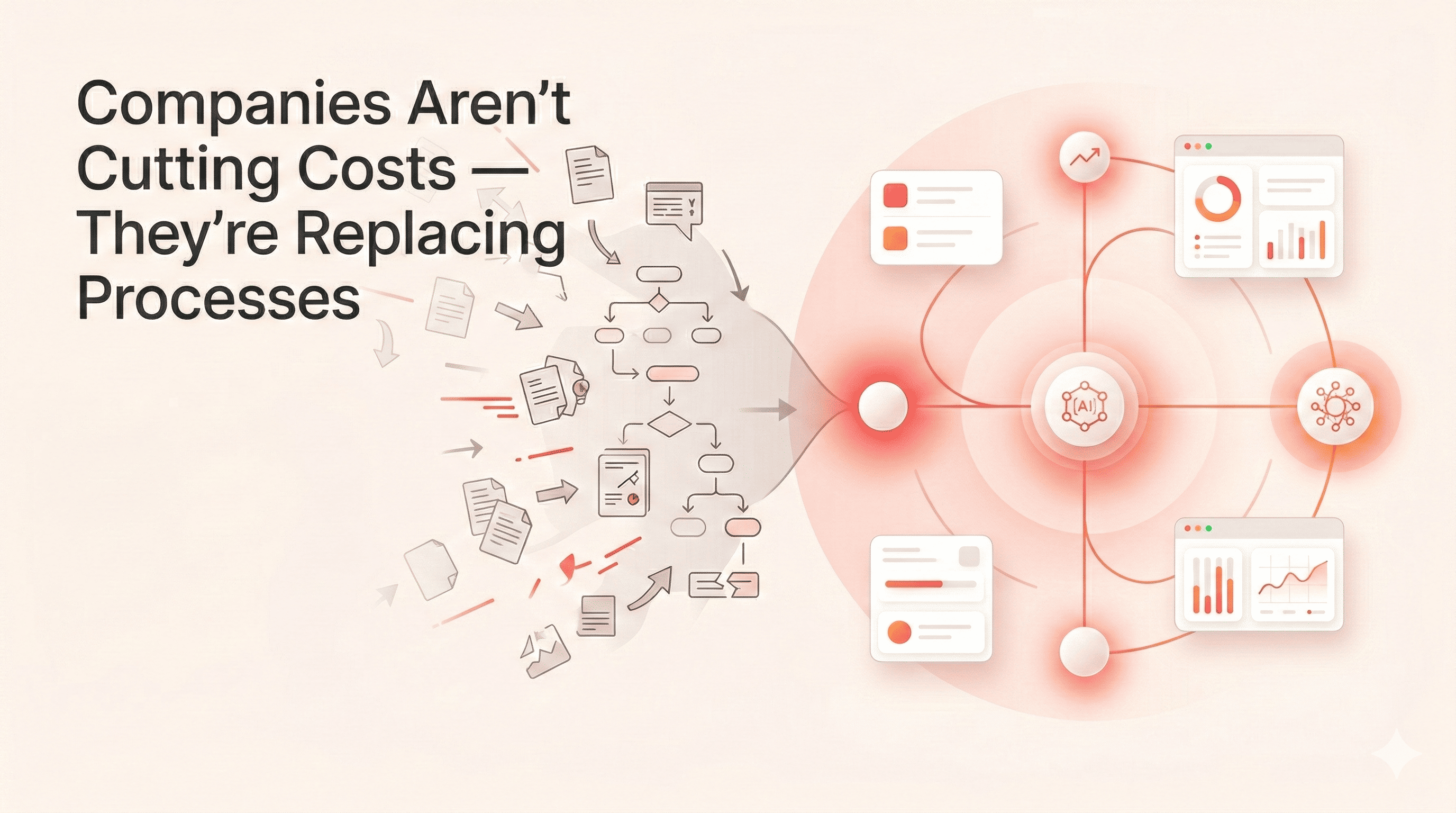
For years, when economic pressure increased, companies followed the same pattern.
They froze hiring. They reduced budgets. They cut departments. They renegotiated contracts.
Cost cutting became the symbol of discipline.
But something fundamental has changed.
Today, the most competitive companies are not asking how to reduce expenses. They are asking which processes should no longer exist.
That shift is redefining modern business strategy.
The Old Model: Cut Spending, Keep the Structure
Traditional cost cutting assumes that the system itself is correct.
The workflow stays the same. The reporting layers remain. The approval chains continue. The manual coordination persists.
Leaders simply reduce the inputs and expect the same output.
But this approach has limits. You can only shrink so much before performance declines. In a fast moving AI driven economy, shrinking does not create advantage. Redesigning does.
If your delivery process is already stretched, cutting costs often creates slower response times, more errors, and lower customer satisfaction. Replacing processes reduces friction without shrinking capability.
The Real Cost Inside Most Businesses
Most companies do not realize where their real expense lives. It is not just payroll. It is friction.
Friction shows up in data transfer between systems, manual report generation, repetitive customer follow ups, approval bottlenecks, and internal coordination loops.
These steps feel normal because they evolved over time. Many were built before automation and AI could handle cognitive tasks at scale.
What used to require people can now be streamlined or eliminated entirely. The cost is not the employee. The cost is the outdated process.
- Work depends on manual copy and paste between tools
- Follow ups rely on memory instead of systems
- Approvals happen in long email threads
- Reports are rebuilt from scratch each week
- Customers wait because messages sit unanswered
Why Process Replacement Is Different
Cutting costs reduces capacity. Replacing processes increases leverage.
When a workflow is redesigned using automation, tasks happen faster, errors decrease, data becomes cleaner, teams focus on higher value decisions, and scaling becomes predictable.
For example, instead of manually qualifying leads, drafting follow ups, and updating CRM records, a company can implement automated workflows that handle those steps instantly.
The sales team is not reduced. It becomes more strategic. Execution compresses. Judgment expands.
If you want the strategic foundation behind scaling workflows, read about what it really means to scale automation across your organization.
The White Collar Shift
Many believed automation would first disrupt manual labor. In reality, knowledge work is being reshaped faster.
Marketing workflows. HR screening systems. Finance reconciliation processes. Operations coordination pipelines.
These environments are structured and rule based, which makes them ideal for automation.
The impact is not elimination of professionals. It is elevation of their roles. Instead of spending hours compiling data, teams interpret insights. Instead of coordinating manually, they optimize strategy.
This is not a reduction story. It is a redesign story.
This shift accelerates when businesses start training and managing digital coworkers inside growing teams.
The Compounding Advantage
Process replacement creates long term structural benefits. Once a workflow is automated properly, the gains continue.
Reporting time shrinks permanently. Response times improve permanently. Error rates decline permanently.
These improvements compound year after year.
Cost cutting delivers immediate relief. Process redesign delivers ongoing leverage. That difference matters.
For a broader lens on how technology reshapes work and productivity, see the Brookings analysis on the effects of AI on firms and workers. Read the Brookings article.
Why Many Companies Still Default to Cutting
Redesigning systems requires clarity. It forces leaders to examine why certain steps exist, whether approval layers are necessary, where manual effort is redundant, and how departments interact.
Cost cutting feels faster. Process replacement feels transformative. But transformation is what builds resilience.
Companies that repeatedly cut without redesigning become lean but fragile. Companies that replace processes become lean and scalable.
If you are mapping workflows, start with implementing business process automation to reduce manual workflows.
The New Executive Question
Modern leadership thinking is shifting.
Instead of asking how to reduce operating expenses, smart leaders ask what their workflows would look like if they built the company today using automation and AI from the start.
Because if you were designing from scratch today, you would not copy data manually between systems, track approvals through email threads, draft repetitive responses by hand, or generate reports through spreadsheet gymnastics.
You would build intelligent systems.
The Hybrid Operating Model
The future is not fully automated. It is hybrid.
Humans bring strategic thinking, creativity, emotional intelligence, negotiation, and leadership. Automation brings speed, consistency, data processing, workflow routing, and scale.
When companies intentionally design around this partnership, they do not shrink. They strengthen.
Many companies accelerate this hybrid model by adopting scalable AI employee systems that remove manual operational drag.
The Competitive Divide Ahead
Over the next decade, a clear separation will form.
Companies focused only on cutting costs will manage pressure quarter by quarter. Companies focused on replacing processes will build structural advantage.
One reacts. The other redesigns. One reduces temporarily. The other improves permanently. That difference compounds.
Final Thought
The most expensive thing in modern business is not payroll. It is inefficiency embedded inside legacy workflows.
Companies that recognize this stop obsessing over expense reduction and start eliminating friction.
Cost cutting is defensive. Process replacement is strategic. And strategy is what scales.