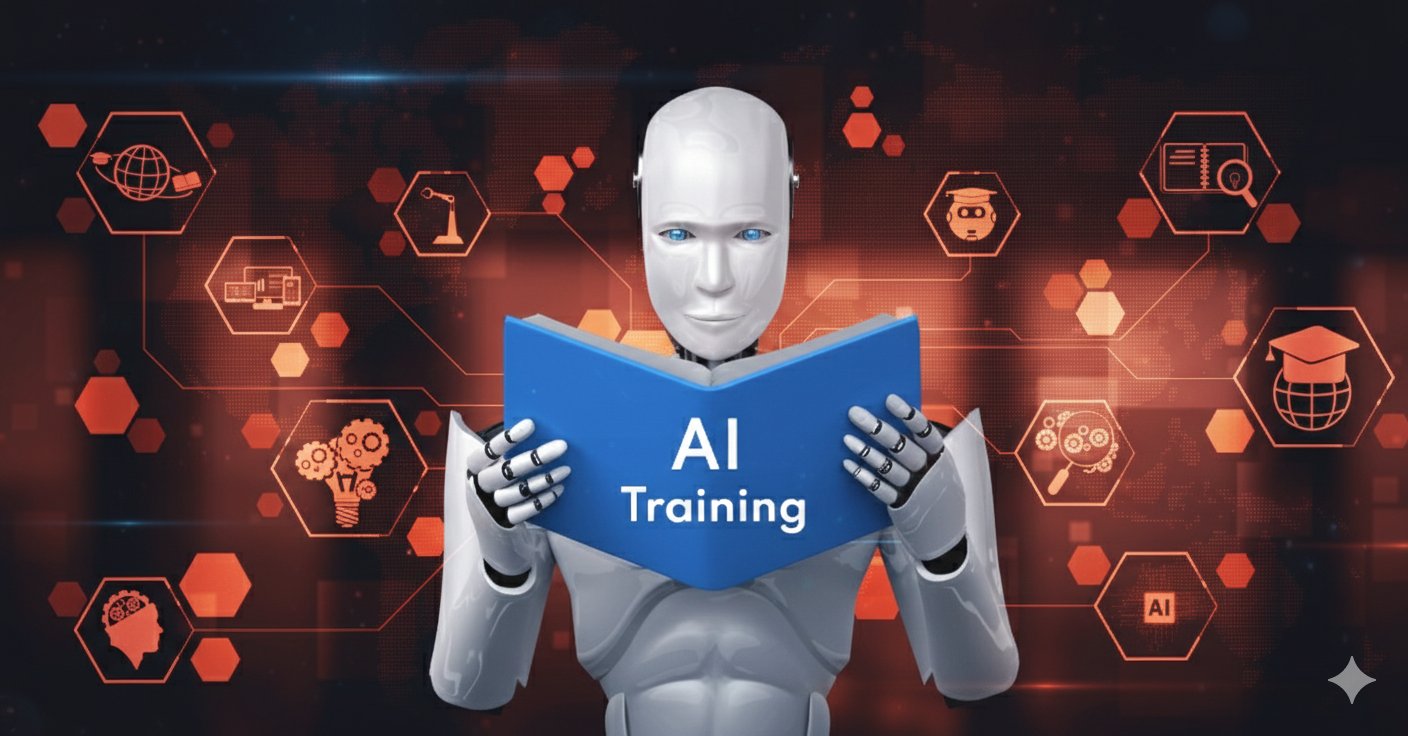
Artificial intelligence does not fail because the technology is weak. It fails because it is untrained.
Many businesses install AI tools expecting instant results. When performance is inconsistent, they assume AI does not work. The reality is much simpler: AI employees must be onboarded, trained, and optimized just like human team members.
This is why AI employee training is the foundation of every scalable digital workforce.
When done correctly, training transforms generic systems into intelligent, role-based digital workers that execute processes, make decisions, and support growth with speed and consistency.
Training is how the best AI employees become operational powerhouses.
Core idea
The difference is not the AI. It’s the training framework behind it.
Why AI Employee Training Matters
Untrained AI behaves like an intern with no instructions. Trained AI behaves like your most reliable operations manager.
Without training, AI:
- Misinterprets requests
- Produces inconsistent outputs
- Fails to follow workflows
- Cannot adapt to business logic
With proper training, AI:
- Executes tasks correctly
- Understands context
- Follows operational rules
- Learns from patterns
- Improves over time
At Scale Through Automation (STA), we’ve trained AI Employees across industries; from professional services and healthcare to logistics, real estate, and operations-heavy companies. The result is consistent: training is what turns “AI tools” into operational systems.
What “Training” Means for an AI Employee
Training does not mean writing code or building models.
It means teaching your AI:
- How your business operates
- What decisions look like
- Where data lives
- How tasks flow
- When actions should trigger
Simple definition
Training is business logic translation; mapping real operations into a system that runs without constant oversight.
This is the exact methodology STA uses when training AI Employees for client operations: we map real business logic into workflows that execute consistently.
Data, Prompts, and Workflow Mapping
Every effective AI employee is built on three pillars:
Your AI must understand your services, pricing, offers, customers, and policies.
Without data, AI guesses. With data, AI reasons.
Prompts define how your AI thinks and responds. They control tone, decision logic, response structure, and escalation rules.
Prompts are the job descriptions of AI employees.
This is where most businesses struggle. Workflows define triggers, next steps, handoffs, system updates, and end conditions.
Workflow-first training is how AI Employees run operations—not just respond to messages.
Role-Based AI Employee Training
The best results come from specialized digital workers; not one general AI.
Each role requires its own:
- Rules
- Data
- Prompts
- Workflows
Why role clarity matters
Scaling works when each digital worker knows exactly what it owns and what it escalates.
Testing, Monitoring, and Optimization
Training is not a one-time event. It is a continuous process.
You must:
- Review outputs
- Track accuracy
- Monitor completion rates
- Refine prompts
- Adjust workflows
Every improvement compounds.
This ongoing optimization is part of how STA supports clients long-term; ensuring AI Employees evolve as the business evolves.
Common Training Mistakes
- Skipping workflow documentation
- Feeding outdated or poor-quality data
- Overloading one AI with too many roles
- Not monitoring performance
- Treating training as “set and forget”
Why this matters
These mistakes cause frustration, not automation.
How Trained AI Employees Outperform Human-Only Teams
| Human Teams | Trained AI Employees |
|---|---|
| Forget tasks | Never forget |
| Miss follow-ups | Work 24/7 |
| Work limited hours | Execute consistently |
| Make inconsistent decisions | Follow rules perfectly |
This is why companies that invest in AI employee training experience:
And this is how they build the best AI employees; not through software, but through systems.
Final Thought
AI does not replace people. It replaces manual work.
When you train your AI employees correctly, you are not installing technology. You are building a digital workforce that scales your business, protects your time, and multiplies your output.